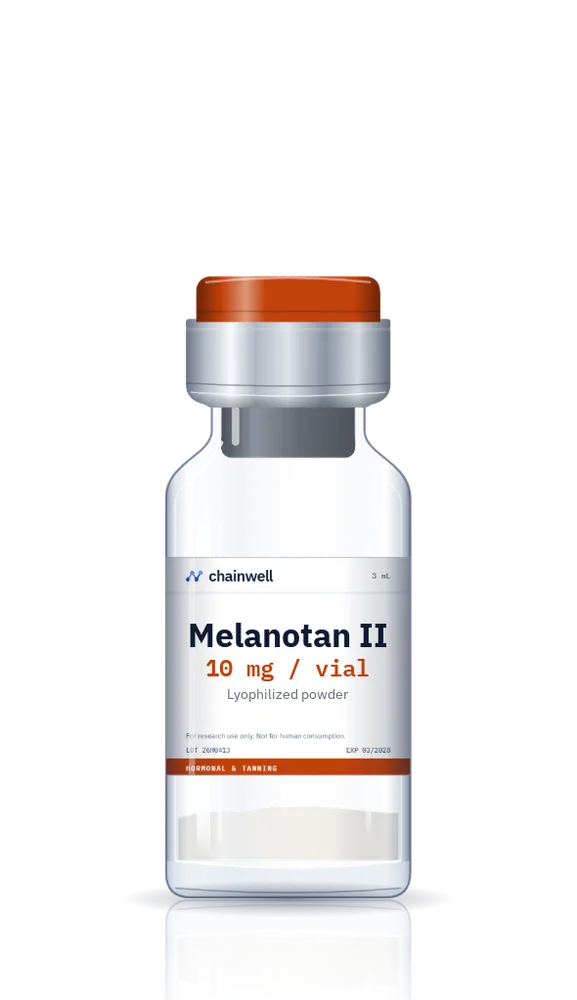
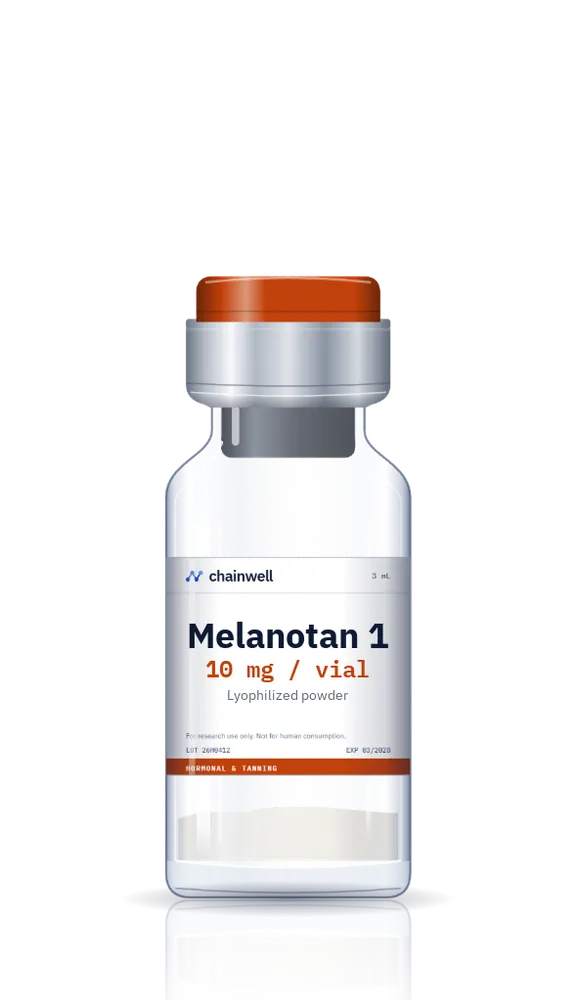
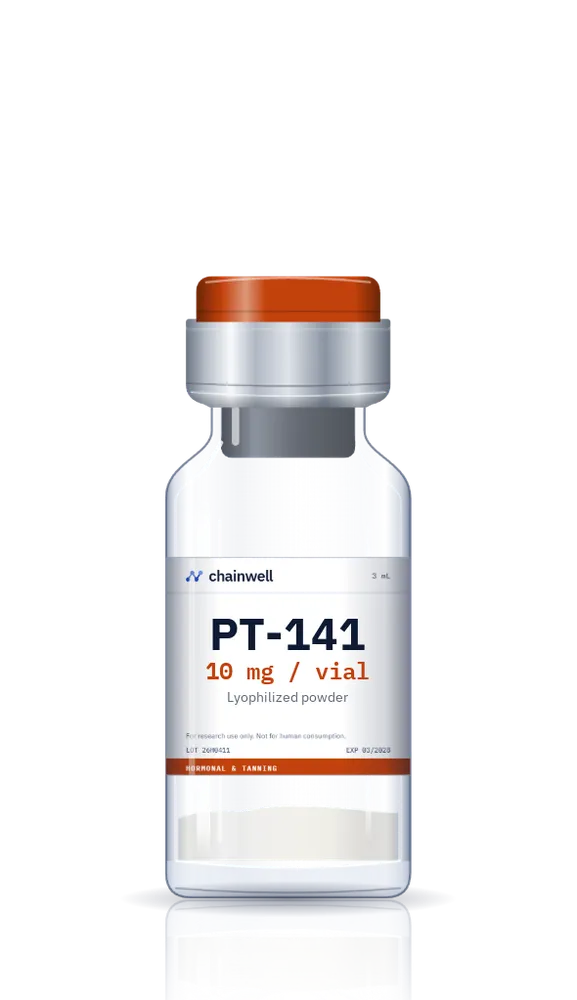
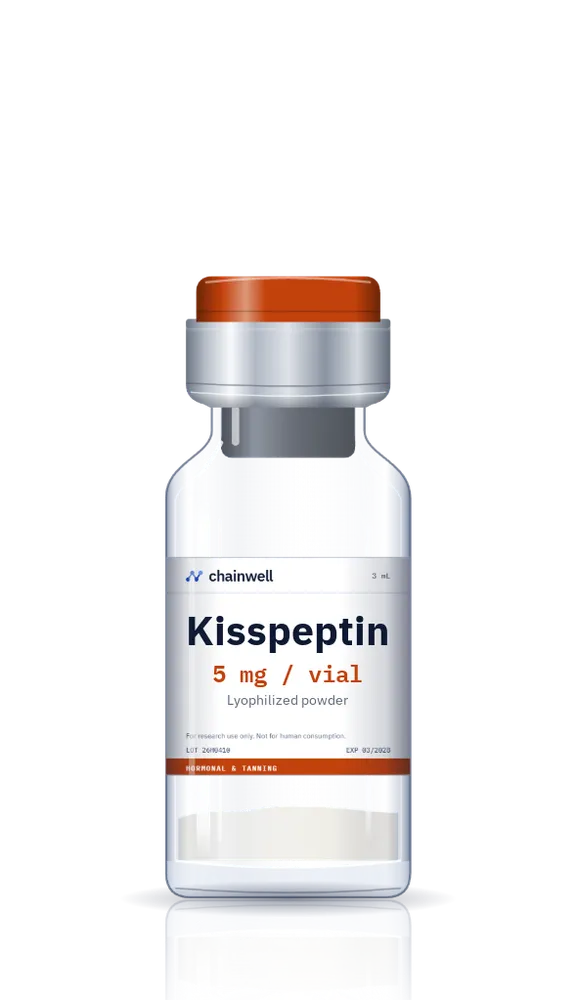
Melanotan 1 vs 2 at a glance
All three compounds in this family are analogues of alpha-melanocyte stimulating hormone (alpha-MSH), the 13-residue peptide that tells melanocytes to make eumelanin via the MC1R receptor. They were developed at the University of Arizona in the 1980s and 1990s, then went in three very different directions.
| Melanotan 1 (afamelanotide) | Melanotan II | PT-141 (bremelanotide) | |
|---|---|---|---|
| Structure | Linear 13-residue peptide, [Nle4, D-Phe7]-alpha-MSH | Cyclic lactam heptapeptide, Ac-Nle-cyclo[Asp-His-D-Phe-Arg-Trp-Lys]-NH2 | Cyclic heptapeptide closely related to Melanotan II, differing at the C-terminus |
| Receptor profile | Mainly MC1R (pigmentation) | Broad: MC1R, MC3R, MC4R, MC5R | Studied for central MC4R effects |
| Approved product | Scenesse 16 mg implant (EU 2014, US 2019, TGA 2020) for erythropoietic protoporphyria | None, anywhere | Vyleesi injection (US FDA, 2019) for low sexual desire in premenopausal women |
| Main research use | Pigmentation and photoprotection models | Broad melanocortin receptor pharmacology | Central melanocortin signalling |
The practical difference for a researcher is receptor coverage. If the question is about pigment production at MC1R, Melanotan 1 is the cleaner tool. Melanotan II activates several receptor subtypes at once, which explains both its potency and its long list of off-target effects.
Melanotan 1: from research peptide to TGA-registered implant
Afamelanotide was taken forward by Clinuvel Pharmaceuticals, a Melbourne company, as a controlled-release implant rather than an injection. The pivotal evidence came from two randomised, placebo-controlled trials published by Langendonk and colleagues in the New England Journal of Medicine in 2015 (74 patients in Europe, 94 in the United States) in erythropoietic protoporphyria (EPP), a genetic condition that causes severe pain on sunlight exposure. In the US trial, median pain-free time in direct sunlight over six months was 69.4 hours with afamelanotide versus 40.8 hours with placebo. Adverse events were mostly mild, and serious events were not thought to be drug-related.
The TGA approved Scenesse in October 2020 for the prevention of phototoxicity in adults with EPP, the first EPP treatment registered in Australia. It is inserted by a trained health professional. That registration covers Clinuvel's implant for EPP only. It does not make research-grade Melanotan 1 a registered medicine, and it is not a tanning approval.
Melanotan II: what the only early human study found
Melanotan II was built to be more potent and more stable than Melanotan 1 by cyclising it into a seven-residue ring. The one published pilot phase I study, Dorr and colleagues (Life Sciences, 1996), gave small subcutaneous doses to healthy male volunteers over two weeks. Tanning activity appeared in the face, upper body and buttocks after only five doses. So did the effects that ended its path as a tanning drug: mild nausea at most dose levels, a stretching and yawning complex, spontaneous erections lasting one to five hours, and grade II somnolence and fatigue in one subject at the top dose.
Those erections are the reason PT-141 exists. The sexual effects of Melanotan II pointed researchers to central MC4R signalling, and bremelanotide was developed from it for that purpose. Melanotan II itself was never approved for any use in any country.
Melanotan II side effects in published case reports
Most of what is known about melanotan ii side effects comes from dermatology case reports in people who used unlicensed tanning products, not from trials. Langan and colleagues reported changing moles linked to the "sun tan jab" in the BMJ in 2009, with lesions on biopsy ranging from benign to severely dysplastic naevi. Paurobally and colleagues described melanotan-associated melanoma in the British Journal of Dermatology in 2011. Further reports describe eruptive and atypical naevi appearing within weeks of first use. Other published case reports have described priapism, rhabdomyolysis and acute kidney injury.
Two cautions apply. Case reports cannot prove causation; a 2023 UNSW explainer on the TGA warning notes that definitive proof of a melanoma link has not been established. And the products involved were of unknown content, so dose and purity were unknowable. Neither caution makes the signal reassuring: rapidly changing moles are exactly what dermatologists look for in early melanoma, and Melanotan II makes them harder to read.
Melanotan II before and after photos, injections and nasal sprays: the TGA position
The TGA has warned Australians repeatedly against melanotan tanning products. Its position, stated on tga.gov.au, is that melanotan is a prescription-only medicine, is not approved as a tanning agent, and that supplying tanning products containing it without a prescription is illegal whatever the form: injection, nasal spray, tablet or cream. These products have not been assessed for quality, safety or efficacy.
The regulator has also tested what is being sold. In a safety alert, TGA laboratory analysis of five nasal spray bottles all labelled "30 mg" found between 22 mg and 54 mg of Melanotan II per bottle, and the individual supplying them was issued 27 infringement notices. That is the problem with melanotan ii injections and melanotan ii nasal spray products sold for tanning: the label does not tell you what is inside.
Melanotan ii before and after photos on social media are the marketing arm of that trade. They show colour, not safety, not dose and not what happened to the person's moles. Our view is blunt: a before and after image is a warning sign about where a product is being sold, and none of our melanocortin peptides are for tanning or any human use.
Where PT-141 fits
Bremelanotide was approved by the US FDA in June 2019 as Vyleesi, an autoinjector for acquired, generalised hypoactive sexual desire disorder in premenopausal women. Its label shows the family resemblance: nausea in 40 percent of patients in trials, and focal hyperpigmentation of the face, gums or breasts in about 1 percent, which may not resolve after stopping. Even a compound optimised away from pigmentation still touches MC1R.
For research on central melanocortin signalling, the PT-141 research peptide is the targeted option, and the PT-141 reconstitution calculator handles lab solution maths. Researchers studying hypothalamic reproductive signalling through a different pathway often compare it with kisspeptin, which acts on the KISS1 receptor rather than any melanocortin receptor.
Choosing between them for research
For pigmentation and photoprotection models, Melanotan 1 is the better tool: one main receptor, a human evidence base, and an approved relative. Melanotan II is the right choice only when broad melanocortin activation is the point of the experiment. PT-141 sits between them for MC4R-focused work. All three are in our melanocortin peptide collection, each lot with a certificate on the COA lookup.
Chainwell Peptide supplies these compounds for laboratory research only. They are not for human or veterinary use, not for tanning, and nothing here is dosing advice. Lyophilised vials are best kept cold and dark; our peptide storage guide explains why melanocortin peptides with tryptophan residues are sensitive to light and oxidation.
Frequently asked questions
Is Melanotan 1 or Melanotan 2 stronger?
+
Melanotan II is more potent per milligram. Its cyclic structure makes it more stable and it activates several melanocortin receptors (MC1R, MC3R, MC4R and MC5R), while Melanotan 1 acts mainly at MC1R. That broader activity is also why Melanotan II causes nausea, yawning and erections, effects rarely associated with afamelanotide.
Is Melanotan 1 the same as Scenesse?
+
Scenesse is a 16 mg controlled-release implant of afamelanotide, which is the same molecule as Melanotan 1. It is registered by the TGA only for preventing phototoxicity in adults with erythropoietic protoporphyria and is inserted by a trained health professional. Research-grade Melanotan 1 is not Scenesse and is not a registered medicine.
Is Melanotan II legal for tanning in Australia?
+
No. The TGA states melanotan is a prescription-only medicine that is not approved as a tanning agent, and that supplying tanning products containing it without a prescription is illegal in any form, including injections and nasal sprays. The TGA has issued infringement notices to people supplying these products.
What are the main Melanotan II side effects?
+
The 1996 pilot human study recorded nausea, yawning and stretching, spontaneous erections and fatigue. Case reports in users of unlicensed tanning products describe new or rapidly changing moles, dysplastic naevi and melanoma, plus isolated reports of priapism and kidney injury. Case reports cannot prove causation, but the pattern concerns dermatologists.
Is a Melanotan II nasal spray different from injections?
+
The TGA treats them the same: tanning products containing melanotan are illegal to supply without a prescription whatever the form. Its laboratory testing of nasal sprays labelled 30 mg found 22 to 54 mg per bottle, so the dose in unregulated sprays can be far from the label.