What is retatrutide peptide made of?
Is retatrutide a peptide? Yes. It is a chain of 39 amino acids, built on a backbone derived from GIP (glucose-dependent insulinotropic polypeptide) and engineered so that the same chain also switches on the GLP-1 and glucagon receptors. It is not a steroid and has nothing in common with anabolic steroids chemically or pharmacologically.
Three details in the sequence do most of the work:
- Non-coded amino acids. Aminoisobutyric acid (Aib) at positions 2 and 20, and alpha-methyl-L-leucine at position 13. Aib at position 2 protects the peptide from DPP-4, the enzyme that cuts native GLP-1 and GIP within minutes.
- A fatty acid side chain. A C20 fatty diacid is attached through a linker to the lysine at position 17. It binds albumin in the blood, which slows clearance.
- A C-terminal tail shared with the exendin family, which helps stabilise the molecule.
The molecular weight is roughly 4.73 kDa. That figure matters in the lab, because it is exactly what a mass spectrometry identity test checks against.
How does retatrutide work?
Retatrutide works by acting on three receptors that each control a different part of energy balance:
- GLP-1 receptor: glucose-dependent insulin release, slower gastric emptying and satiety signalling in the brain. This is the receptor semaglutide targets.
- GIP receptor: the second incretin pathway, involved in insulin release and fat tissue handling of lipids. Tirzepatide adds this to GLP-1.
- Glucagon receptor: acts mainly on the liver, increasing energy expenditure and fat breakdown. This is the part that is new.
The balance is deliberately uneven. Structural work published in Cell Discovery in 2024 summarised retatrutide as about 8.9 times more potent than native GIP at the GIP receptor, but only about 0.4 times as potent as native GLP-1 and 0.3 times as potent as native glucagon at their receptors. So what does retatrutide do in practice? It leans hardest on GIP, keeps enough GLP-1 activity for appetite effects, and adds partial glucagon activity to push energy expenditure and liver fat loss without the blood sugar rise full glucagon agonism would cause.
Retatrutide half-life
The retatrutide half life in humans is about six days, reported from the phase 1b multiple-ascending-dose trial in people with type 2 diabetes (Urva et al., The Lancet, 2022). That is why every clinical trial has used once-weekly dosing. For comparison, native GLP-1 lasts about two minutes in circulation and native GIP only a few minutes, so the albumin-binding fatty acid is the reason retatrutide is usable at all.
In the lab, the half-life that matters is shelf stability rather than plasma clearance. Freeze-dried retatrutide keeps best frozen at minus 20 °C, and a reconstituted vial is kept at 2 to 8 °C and used within 28 days. Our peptide storage guide covers why, and the retatrutide calculator handles reconstitution volumes for each vial size.
Retatrutide benefits reported in clinical trials
The benefits of retatrutide reported so far are trial outcomes, not proven clinical benefits, since no regulator has reviewed them. The main findings:
- Weight. In the phase 2 obesity trial (New England Journal of Medicine, 2023), the 12 mg group lost an average of 24.2% of body weight at 48 weeks, against 2.1% on placebo. In the phase 3 TRIUMPH-1 trial, Lilly reported 28.3% at 80 weeks on 12 mg.
- Blood glucose. In type 2 diabetes, HbA1c fell by up to 2.02 percentage points at 24 weeks in the phase 2 trial (The Lancet, 2023), and by up to about 2.0 points at 40 weeks in the phase 3 TRANSCEND-T2D-1 trial.
- Liver fat. In the phase 2a substudy (Nature Medicine, 2024), liver fat fell by 86.0% at 48 weeks on 12 mg.
- Joint pain. TRIUMPH-4, in people with knee osteoarthritis, reported large improvements in pain scores alongside 28.7% weight loss at 68 weeks on 12 mg.
Our retatrutide results guide breaks these down week by week and dose by dose.
What is retatrutide used for?
Right now, retatrutide is used in two settings only: registered clinical trials, and laboratory research. Lilly is studying it for obesity, type 2 diabetes, obstructive sleep apnoea, knee osteoarthritis pain, chronic low back pain, kidney disease and cardiovascular outcomes. In July 2026 Lilly said it planned to file with the US FDA in the first quarter of 2027, later than first signalled, to gather more manufacturing and quality data.
In research labs, retatrutide is a tool compound for studying how the three receptors interact. Because one molecule hits all three, a study can compare it against a dual agonist such as tirzepatide, a GLP-1-only compound, or an amylin analogue such as cagrilintide to separate what each pathway contributes. The side-by-side detail is in our retatrutide vs tirzepatide guide.
Side effects in brief
The trial side effects follow the incretin pattern: mostly nausea, diarrhoea, vomiting and constipation, dose related and concentrated during escalation, plus a rise in resting heart rate. Phase 3 added a skin-sensation effect, dysesthesia, at higher doses. The full numbers are in our guide to retatrutide side effects.
In Australia, retatrutide is not on the ARTG and the TGA has warned against using it outside clinical trials, after tests on products sold as retatrutide found contamination or the wrong drug entirely.
Research formats from Chainwell Peptide
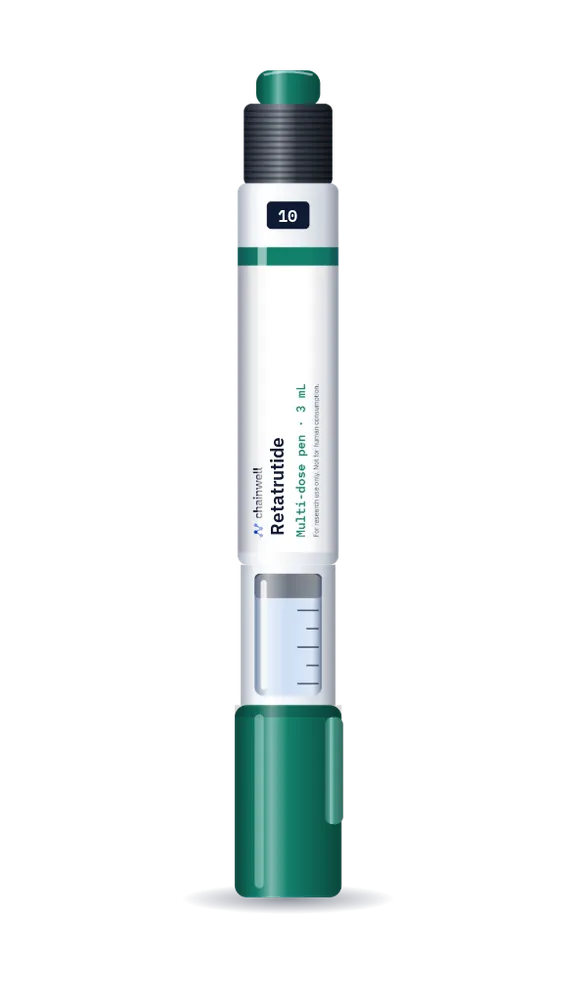
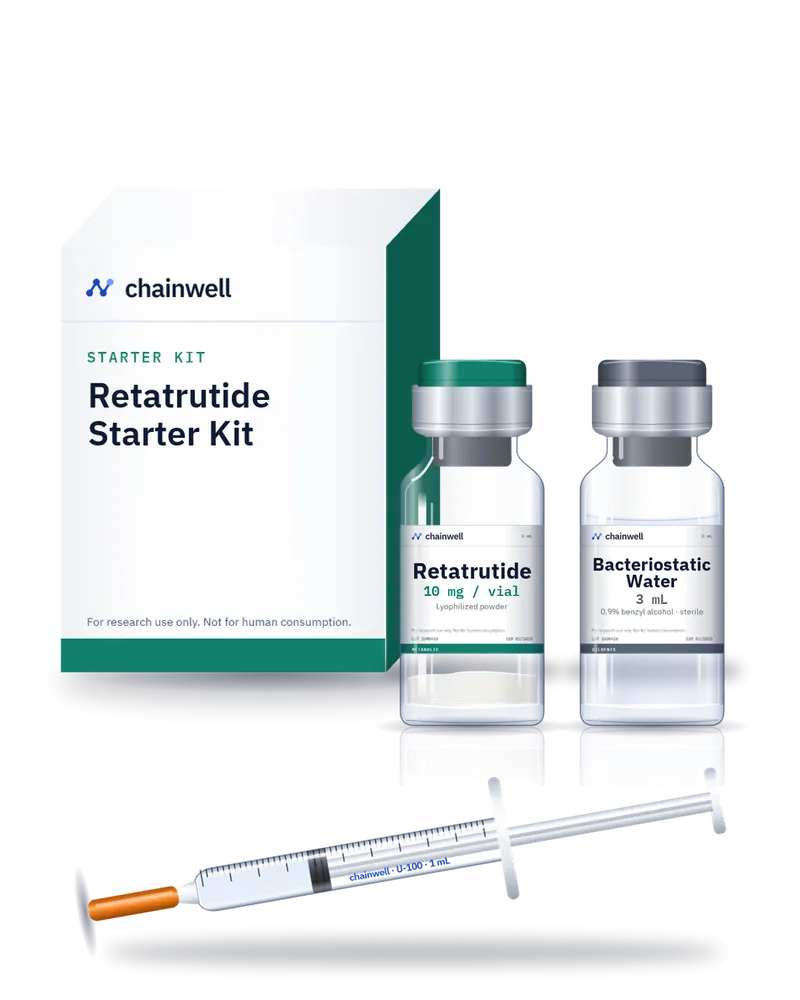
Chainwell Peptide supplies retatrutide as freeze-dried powder in 10, 20 and 30 mg vials, and as the Retatrutide Pen, which holds 10 mg in solution in a 3 mL multi-dose cartridge for labs that would rather skip reconstitution. Every lot is tested by an independent laboratory for identity by mass spectrometry and purity by HPLC, and you can match your vial's lot number on the COA lookup page. The rest of the incretin and amylin compounds sit in our metabolic research peptides range.
Research use only: all Chainwell Peptide products are sold for laboratory research and are not for human or veterinary use.
Frequently asked questions
What does retatrutide do?
+
Retatrutide activates three receptors: GLP-1 and GIP, which drive insulin release and appetite signalling, and glucagon, which raises energy expenditure and reduces liver fat. In trials this produced weight reductions of up to 24.2% at 48 weeks in phase 2 and 28.3% at 80 weeks in phase 3, plus improved blood glucose in type 2 diabetes.
Is retatrutide a peptide?
+
Yes. Retatrutide is a 39 amino acid peptide built on a GIP-derived backbone, with non-natural amino acids that resist enzyme breakdown and a C20 fatty acid chain that binds albumin. It is not a steroid. Its molecular weight is about 4.73 kDa, which is what mass spectrometry confirms in an identity test.
What is the half-life of retatrutide?
+
The half-life of retatrutide in humans is about six days, based on the phase 1b trial published in The Lancet in 2022. The long half-life comes from the fatty acid side chain binding albumin in the blood, and it is why all clinical trials have used once-weekly administration.
Who makes retatrutide?
+
Retatrutide was discovered and is being developed by Eli Lilly, the company behind tirzepatide (Mounjaro). Its research code is LY3437943. Lilly runs the TRIUMPH phase 3 programme for obesity and related conditions and the TRANSCEND programme for type 2 diabetes, and has said it plans to file with the US FDA in early 2027.
Is retatrutide approved?
+
No. At the time of writing, retatrutide is not approved by the FDA, the TGA or any comparable regulator, and it is not on the Australian Register of Therapeutic Goods. Lilly has said it expects to submit its US application in the first quarter of 2027, with other countries to follow on their own timelines.