Insulin syringes at Chemist Warehouse and other chemists
Yes, Australian chemists sell insulin syringes. At the time of writing, Chemist Warehouse's website listed Livingstone-brand U-100 insulin syringes in boxes of 100, in 0.3 mL, 0.5 mL and 1 mL barrels with needles from 27 to 31 gauge, including a 1 mL insulin syringe with a 29 gauge 13 mm needle. TerryWhite Chemmart listed BD Ultra-Fine 1.0 mL syringes with a 31 gauge 6 mm needle. Ranges change, so check the listing or ask at the counter; not every store holds every size.
Two things to know before you walk in. Chemists usually sell in boxes of 100, which is more than many small labs need. And the syringes most retail customers buy are for people managing diabetes, so the pharmacist may ask what they are for. Chainwell Peptide is not affiliated with Chemist Warehouse or any pharmacy.
The NDSS: free syringes for people with diabetes
The National Diabetes Services Scheme (NDSS) is how most Australians who inject insulin get their syringes. According to the NDSS, people registered with the scheme who use insulin can access pen needles and syringes free of charge, with state and territory governments covering the co-payment. Access requires a certified access form or a copy of an insulin prescription, and the products are collected from an NDSS Access Point, usually a community pharmacy.
The NDSS subsidy is only for registered people with diabetes. It does not apply to laboratory purchases, and nothing about research use qualifies for it.
Insulin syringes for sale for laboratory use
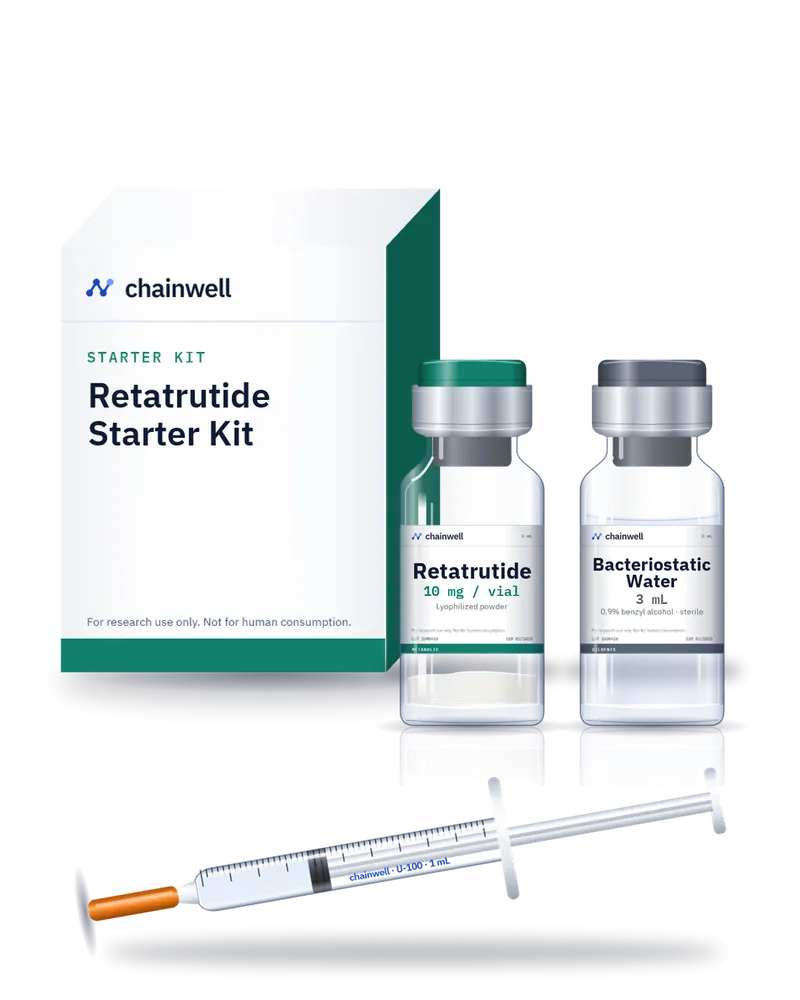
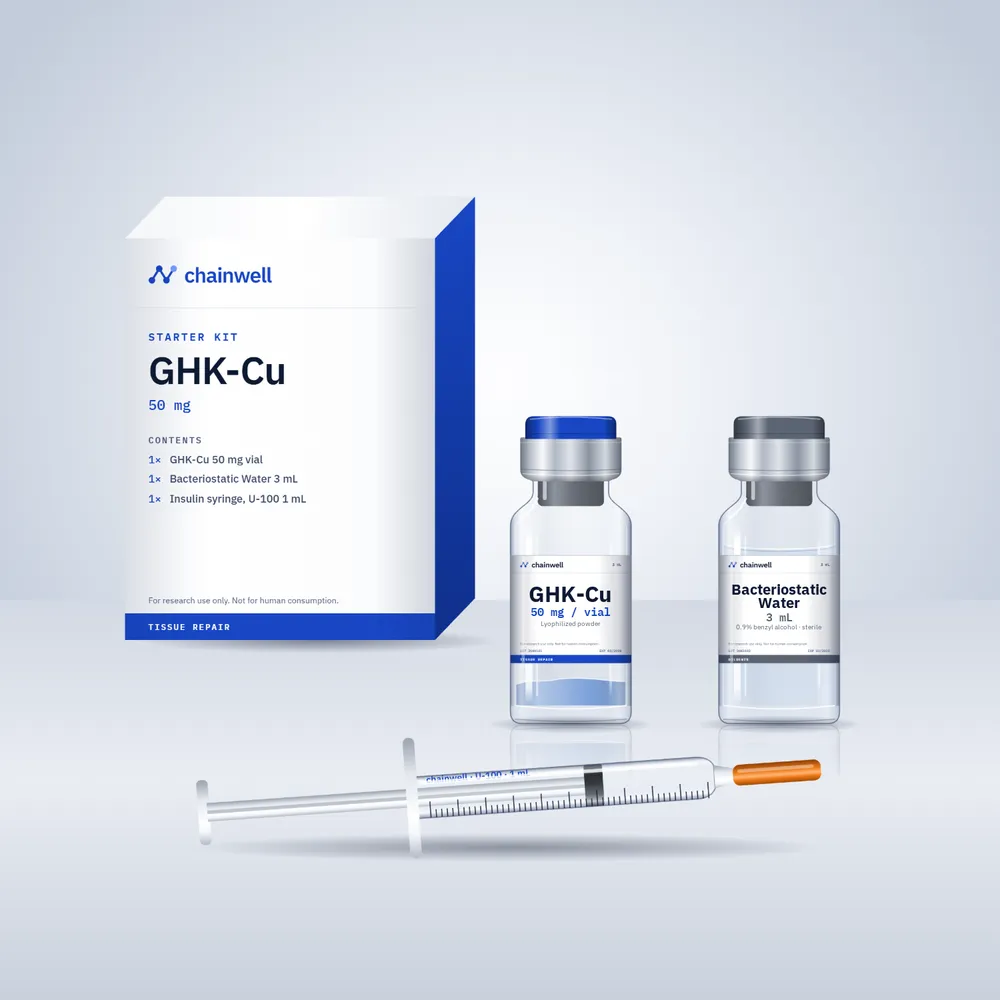
In peptide research, insulin syringes are measuring tools. They draw diluent from a vial, add it to lyophilized powder, and then measure small, precise volumes of the reconstituted solution. A research supplier's advantage is size matching: you can buy a handful of syringes alongside a vial of bacteriostatic water rather than a box of 100 in one gauge.
Chainwell Peptide sells sterile, single-use U-100 insulin syringes in four configurations:
- 1 mL, 29G, 12.7 mm needle
- 1 mL, 31G, 6 mm needle
- 0.5 mL, 31G, 6 mm needle
- 0.3 mL, 31G, 6 mm needle
U-100 syringes explained: 100 units in 1 mL
A U-100 syringe is graduated for insulin at a concentration of 100 units per mL, so the scale reads in units rather than millilitres. The conversion never changes: 100 units = 1 mL, 10 units = 0.1 mL, 1 unit = 0.01 mL. A 100 unit insulin syringe is simply the 1 mL barrel.
| Barrel | Full scale | Typical marking interval | Smallest step in mL | Best for |
|---|---|---|---|---|
| 0.3 mL | 30 units | 1 unit | 0.01 mL | Very small, precise volumes |
| 0.5 mL | 50 units | 1 unit | 0.01 mL | Small volumes with more headroom |
| 1 mL | 100 units | 2 units | 0.02 mL | Drawing diluent; larger volumes |
Marking intervals vary slightly between brands, so read the printed scale on the barrel you have. The principle is that a smaller barrel spreads the same volume over a longer scale, which makes small measurements more accurate.
29G vs 31G and needle length
Gauge is needle thickness, and the number runs backwards: the higher the gauge, the thinner the needle. A 29G needle has an outer diameter of about 0.33 mm; a 31G needle is about 0.26 mm. In the lab, the thicker 29G draws liquid faster and is less likely to bend when pushed through a firm stopper. The thinner 31G cores less rubber from the stopper, which matters on a vial that will be punctured many times.
Needle length matters for vials too. A 12.7 mm (half-inch) needle reaches the bottom of a tall 10 or 30 mL vial more easily when you are drawing the last of the diluent. A 6 mm needle is fine for 3 mL peptide vials. Our recommendation: use the 1 mL 29G 12.7 mm syringe to draw and add diluent, and a 31G syringe in the 0.3 or 0.5 mL size for measuring small volumes out of the reconstituted vial.
How to read an insulin syringe for peptide reconstitution
Reading units becomes useful once you know the concentration in the vial. The arithmetic has three steps, all of which our peptide calculator does automatically:
- Concentration: divide the peptide mass by the volume of diluent added. A 10 mg vial reconstituted with 2 mL of water holds 5 mg per mL.
- Volume for a given mass: divide the mass you need to measure by the concentration. 0.25 mg at 5 mg per mL is 0.05 mL.
- Convert to units: multiply mL by 100. 0.05 mL is 5 units on a U-100 scale.
A search like "0.25 mg 0.5 ml units how to read insulin syringe" is really asking step 3 backwards: 0.5 mL is 50 units, whatever it contains. Units on these syringes measure volume, not the amount of peptide. The amount depends entirely on how the vial was reconstituted, which is why the same 10 units can hold very different masses in different vials. Compound-specific calculators such as the retatrutide reconstitution calculator build this in, and the reconstitution guide covers the bench procedure.
Chainwell Peptide sells syringes and peptides for laboratory research use only. We do not provide injection instructions or dosing guidance for people or animals. Other consumables are in the water and supplies range.
Frequently asked questions
Does Chemist Warehouse sell insulin syringes?
+
Yes. At the time of writing, Chemist Warehouse's website listed Livingstone U-100 insulin syringes in boxes of 100, in 0.3, 0.5 and 1 mL sizes with needles from 27 to 31 gauge. Availability varies by store, so check the listing or ask the pharmacist. Registered NDSS members who use insulin can get syringes free through NDSS Access Points.
Where can I buy insulin syringes in Australia?
+
Retail chemists sell boxes over the counter, the NDSS supplies them free to registered people with diabetes who use insulin, and research suppliers such as Chainwell Peptide sell U-100 syringes for laboratory measuring, in smaller quantities alongside bacteriostatic water and peptides.
How many units are in a 1 mL insulin syringe?
+
A 1 mL U-100 insulin syringe holds 100 units, so 10 units is 0.1 mL and 1 unit is 0.01 mL. The 0.5 mL barrel holds 50 units and the 0.3 mL barrel holds 30 units. The unit markings measure volume only.
What does U-100 mean on a syringe?
+
U-100 means the scale is calibrated for a solution containing 100 units per mL, so each unit mark equals 0.01 mL. It is the standard insulin concentration in Australia, and U-100 syringes are the standard tool for measuring small volumes from reconstituted research peptide vials.
Is 29G or 31G better?
+
For drawing diluent from a vial, 29G is sturdier and flows faster. For measuring small volumes, 31G cores less rubber from a stopper that will be punctured repeatedly. Many labs keep both: a 1 mL 29G for reconstitution and a 0.3 or 0.5 mL 31G for measuring.