What is bacteriostatic water?
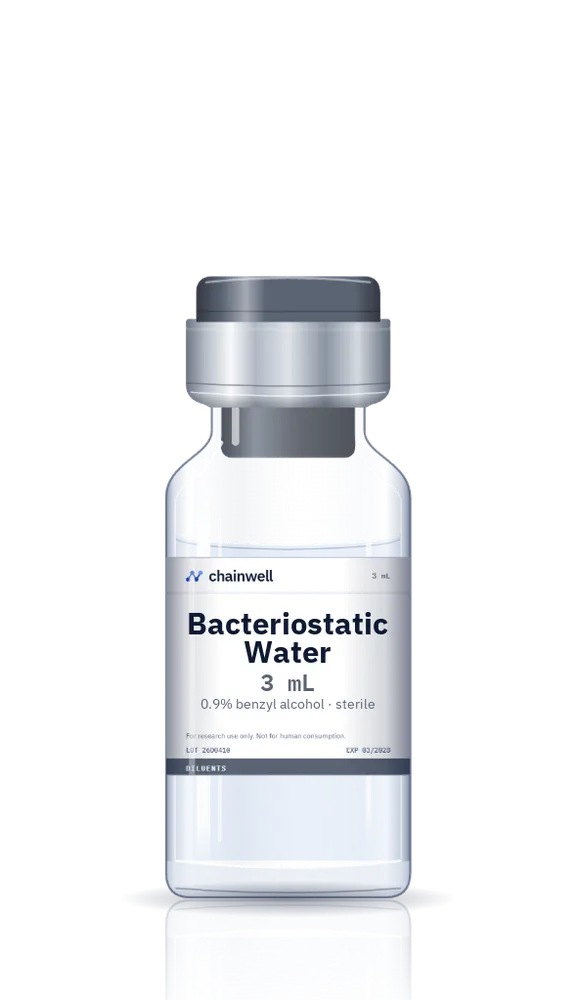
Bacteriostatic Water for Injection is sterile, non-pyrogenic water with benzyl alcohol added as a preservative. The US Pharmacopeia product made by Hospira (Pfizer) contains 9 mg of benzyl alcohol per mL, which is the 0.9% figure you see on most labels, and has a pH of around 5.7 (range 4.5 to 7.0). It is supplied in multiple-dose vials "from which repeated withdrawals may be made to dilute or dissolve drugs", in the manufacturer's own words.
The word bacteriostatic is precise. Benzyl alcohol at this concentration does not sterilise anything: it inhibits the growth and reproduction of bacteria that get into the vial, typically through the stopper on a needle. That is exactly the risk in peptide work, where a single reconstituted vial may be punctured ten or twenty times.
What is bacteriostatic water used for outside the lab? In clinical settings it dilutes or dissolves drugs supplied as powders. The Pfizer label carries two warnings worth knowing even in a research context: it is not for use in neonates, because benzyl alcohol is toxic to newborns, and it should not be injected intravenously on its own because plain water without solutes causes haemolysis.
What sterile water (Water for Injections) is
Sterile water for injection, sold in Australia as Water for Injections BP, is the same highly purified water with no additive at all. No preservative, no buffer, no salt. It comes in single-dose ampoules or vials and the instructions are blunt: use once and discard the remainder. Once the container is open, any microbe that gets in has nothing to stop it.
That makes sterile water ideal when the whole volume is used immediately, or when a preservative would be a problem, for example in cell culture or an assay sensitive to benzyl alcohol. It is a poor choice for a peptide vial that will sit in a fridge and be drawn from for weeks.
Bacteriostatic water vs sterile water compared
| Bacteriostatic water | Sterile water (Water for Injections) | 0.6% acetic acid | |
|---|---|---|---|
| Additive | Benzyl alcohol, usually 0.9% | None | Acetic acid 0.6% |
| Draws per container | Many | One | Few, over a short window |
| After first puncture | Conventionally 28 days | Discard remainder | Follow the method |
| Main peptide use | Default diluent for most lyophilized peptides | Single-use preparations, preservative-sensitive assays | Peptides that dissolve poorly at neutral pH, such as IGF-1 LR3 |
| Label cautions | Not for neonates | Hypotonic; single use | Acidic; not a general diluent |
Our view is simple: use bacteriostatic water unless you have a specific reason not to. The two legitimate reasons are an acid-soluble peptide or a preservative-free protocol. Convenience is not one of them, because using single-use water for a multi-draw vial is how contaminated vials happen.
How long does bacteriostatic water last?
There are two clocks. Unopened, a vial lasts until the expiry date printed on the label, stored as labelled; Pfizer specifies 20 to 25 °C for its unopened product. Once punctured, the working convention is 28 days. That figure comes from US Pharmacopeia General Chapter 797, which sets a beyond-use date of 28 days after a multiple-dose container is first entered, unless the manufacturer specifies otherwise. The US CDC repeats the same guidance: date the vial when you first puncture it, and discard it within 28 days unless the manufacturer states a different date, and never beyond the original expiry.
Refrigeration does not reset the clock. Keeping an opened vial at 2 to 8 °C is sensible, particularly once peptide has been added, but the 28 days still runs from the first puncture. Write the date on the label when you open it. Can bacteriostatic water expire? Yes: benzyl alcohol can slowly oxidise, and the stopper is only rated for so many punctures, which is why the printed expiry matters.
Bacteriostatic water for reconstituting peptides
Most lyophilized research peptides, from BPC-157 to GHK-Cu, are reconstituted in bacteriostatic water. The benzyl alcohol does not interfere with these molecules at 0.9%, and it protects a vial that will be drawn from repeatedly. The procedure matters as much as the diluent: add water slowly down the inside wall, swirl rather than shake, and let the powder dissolve fully. Our step-by-step reconstitution guide covers each step, and the reconstitution calculator works out concentration from fill weight and water volume.
Storage after mixing is a separate question from the diluent's own shelf life. Many reconstituted peptides degrade faster in solution than the diluent does, so the practical limit is often the peptide, not the water. The peptide storage guide covers typical windows.
When to use sterile water or acetic acid instead
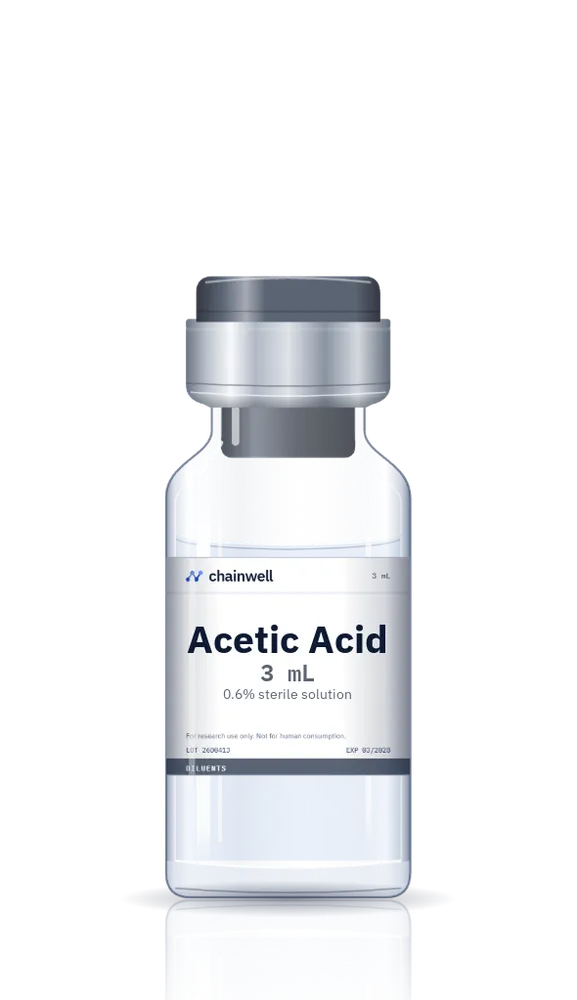
Acetic acid. Some peptides are poorly soluble in neutral water and dissolve cleanly in dilute acid. IGF-1 LR3 is the classic example, and it is commonly reconstituted in 0.6% acetic acid. If a peptide leaves a cloudy suspension in bac water after gentle swirling, check whether its method calls for an acidic diluent before adding more water.
Sterile water. Use it when the entire solution will be used at once, or when benzyl alcohol would affect the experiment, such as some cell culture work. In those cases prepare only what you need and discard the rest.
Bacteriostatic sodium chloride. This is saline with the same preservative. It is a different product and not interchangeable with bacteriostatic water for peptide work unless a protocol specifies it.
For drawing and measuring any of these diluents, sterile U-100 insulin syringes are the standard tool, and the full range sits in our diluents and supplies category. Chainwell Peptide sells all diluents and peptides for laboratory research use only, not for human or veterinary use.
Frequently asked questions
Is sterile water the same as bacteriostatic water?
+
No. Both start as sterile water, but bacteriostatic water has benzyl alcohol added, usually 0.9%, which inhibits bacterial growth after the vial has been punctured. Sterile water has no preservative and is intended for a single use, with the remainder discarded. For multi-draw peptide vials, bacteriostatic water is the usual choice.
How long does bacteriostatic water last once opened?
+
The standard convention is 28 days after the first puncture, from US Pharmacopeia General Chapter 797, unless the manufacturer states otherwise, and never past the printed expiry. Unopened, it lasts until the label expiry when stored as directed. Refrigeration does not extend the 28-day window.
Can I use sterile water instead of bacteriostatic water for peptides?
+
You can if the whole reconstituted vial will be used at once, or if a protocol needs a preservative-free diluent. For a vial that will be drawn from repeatedly over days or weeks, sterile water gives no protection against contamination introduced through the stopper, so bacteriostatic water is preferred.
What is bacteriostatic water for injection?
+
It is the pharmaceutical name for sterile, non-pyrogenic water containing benzyl alcohol as a preservative, supplied in multiple-dose vials to dilute or dissolve drugs. The Hospira product contains 9 mg benzyl alcohol per mL. It is labelled not for use in neonates and not for intravenous injection on its own.
Does bacteriostatic water need to be refrigerated?
+
Not before opening: the Pfizer product is stored at 20 to 25 °C. After a vial is opened, and especially once peptide has been added, many labs keep it at 2 to 8 °C. The 28-day limit after first puncture still applies either way.