
What Is GHK-Cu Peptide?
GHK-Cu is a tripeptide, three amino acids long (glycine, histidine and lysine), with a strong natural affinity for copper. The "Cu" is the copper(II) ion it carries. In cosmetic ingredient lists the same molecule appears as copper tripeptide-1, and in research papers it is usually just called GHK or the copper peptide.
It was identified in 1973 by Dr Loren Pickart, who isolated it from human plasma while studying why liver tissue from older donors behaved more like young tissue when incubated with plasma from younger people. GHK occurs naturally in plasma, saliva and urine, and Pickart's later work reported that plasma levels fall with age, from roughly 200 ng/mL at age 20 to around 80 ng/mL by age 60. That decline is a large part of why GHK-Cu attracts so much research interest.
Copper Peptide GHK-Cu: Why the Powder Is Blue
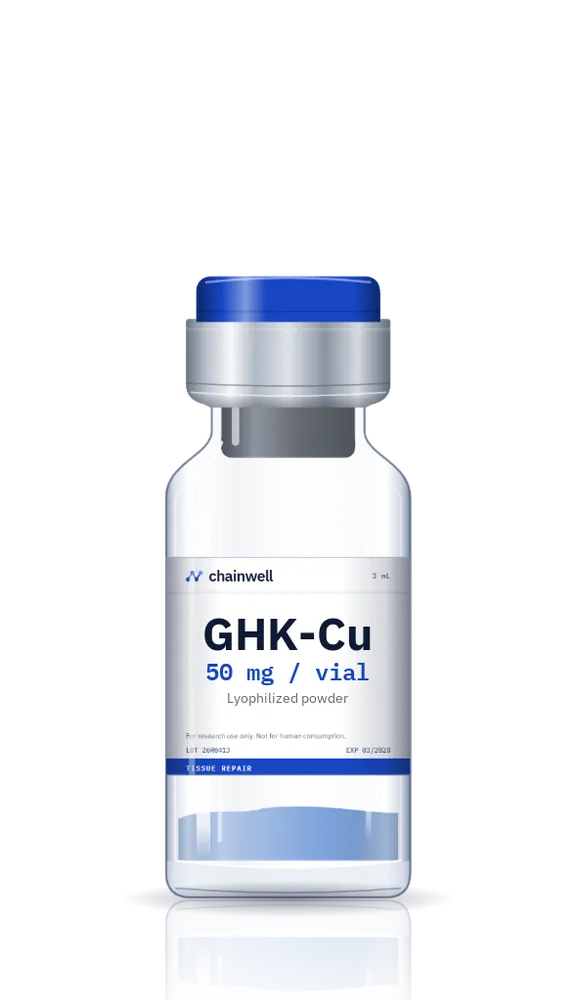
Most lyophilized peptides are white. GHK-Cu is not. The bound copper gives both the powder and the reconstituted solution a distinct blue colour, so the first thing to check when a vial arrives is the cake. Blue is correct. A white or colourless cake in a vial labelled GHK-Cu suggests the copper complex is missing, and you are looking at plain GHK rather than the copper peptide you ordered.
It takes seconds, needs no equipment, and is worth doing alongside the certificate check on every GHK-Cu vial you receive.
What Does GHK-Cu Do? GHK-Cu Peptide Research
GHK-Cu is studied for its role in tissue remodelling, the process by which damaged tissue is broken down and rebuilt. The main lines of research are:
- Collagen synthesis. A 1988 study in FEBS Letters reported that GHK-Cu stimulated collagen production by fibroblasts in culture, at very low concentrations.
- Wound healing. Animal studies have examined GHK-Cu in wound contraction, blood vessel formation and the remodelling of scar tissue.
- Gene expression. Later work by Pickart and colleagues, using the Broad Institute's Connectivity Map, reported that GHK influences the expression of a large number of human genes, many linked to tissue repair and antioxidant defence.
- Copper transport. GHK binds copper tightly enough to carry it, but loosely enough to hand it on to cells, which is thought to explain part of its activity.
Most of this work is in cell culture and animal models. Browse the papers, with links to each, in our GHK-Cu research library.
GHK-Cu 50mg and 100mg Vials
Chainwell Peptide stocks GHK-Cu in two fills, both produced to the same specification and sealed in the same 3 mL glass vial. GHK-Cu is used at higher quantities than most research peptides, which is why our fills are measured in tens of milligrams rather than the single figures typical of peptides like BPC-157.
GHK-Cu 50mg
The GHK-Cu 50mg vial is our standard size and the one we recommend for a first order. It suits new research, method development and labs trying GHK-Cu for the first time, and it is the size included in the GHK-Cu Starter Kit with bacteriostatic water and a syringe.
The smaller fill is also easier to use completely inside the 28 day window after reconstitution, so less material is lost if a study pauses or changes direction.
GHK-Cu 100mg
GHK-Cu 100mg carries twice the peptide of the 50mg vial in a single lot, so repeated assays run from one certificate of analysis instead of two. It is the better buy for labs that already work with GHK-Cu regularly and costs less per milligram.
Choose it when your method is settled and you are confident the reconstituted vial will be used within 28 days. Because the vial is the same 3 mL size, the 100mg fill produces a more concentrated solution for the same volume of water.
GHK-Cu Powder vs Serums and Creams
Many people searching for GHK-Cu are looking for a serum, cream or topical product. Those are cosmetics: they list the peptide as copper tripeptide-1, usually at a low percentage in a finished formula with other ingredients. What we sell is different. Our GHK-Cu powder is the pure research compound, lyophilized with nothing else added, so the concentration and the solvent are entirely your choice.
We do not sell GHK-Cu serums, creams, capsules or tablets. If your work needs the compound itself, verified by lot, the vial is the right format.
Reconstituting GHK-Cu
Reconstituted GHK-Cu is prepared the same way as other lyophilized peptides. Add bacteriostatic water slowly down the inside wall of the vial with a U-100 insulin syringe and swirl gently until the powder dissolves into a clear blue solution. Do not shake it.
How much bac water for 50mg GHK-Cu depends only on the concentration you want. As a worked example, 2 mL added to a 50mg vial gives 25mg per mL, and 2.5 mL gives 20mg per mL. Our peptide reconstitution guide and calculator works out any other volume. Keep the reconstituted vial at 2 to 8 °C, protected from light, and use it within 28 days.
GHK-Cu Kits and Blends
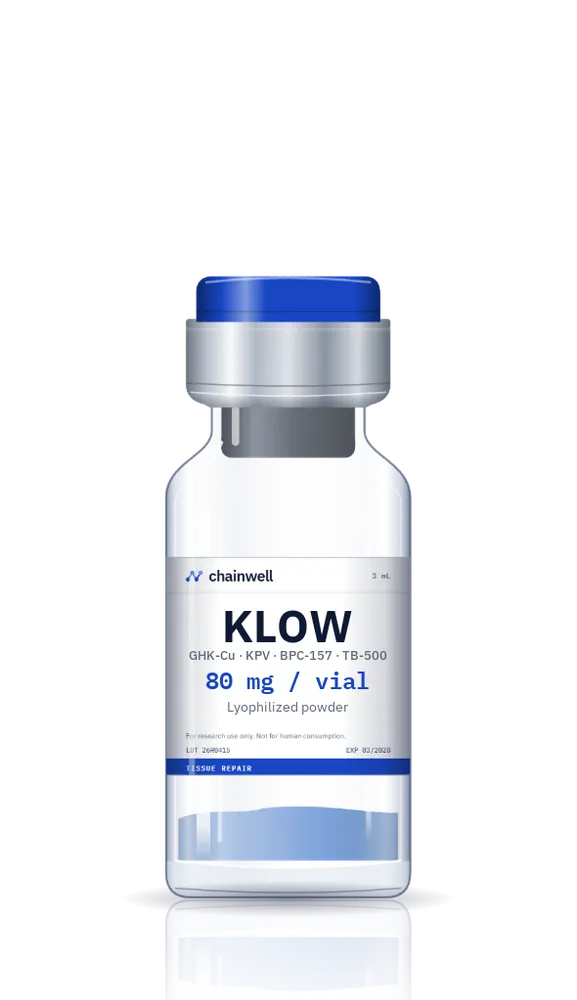
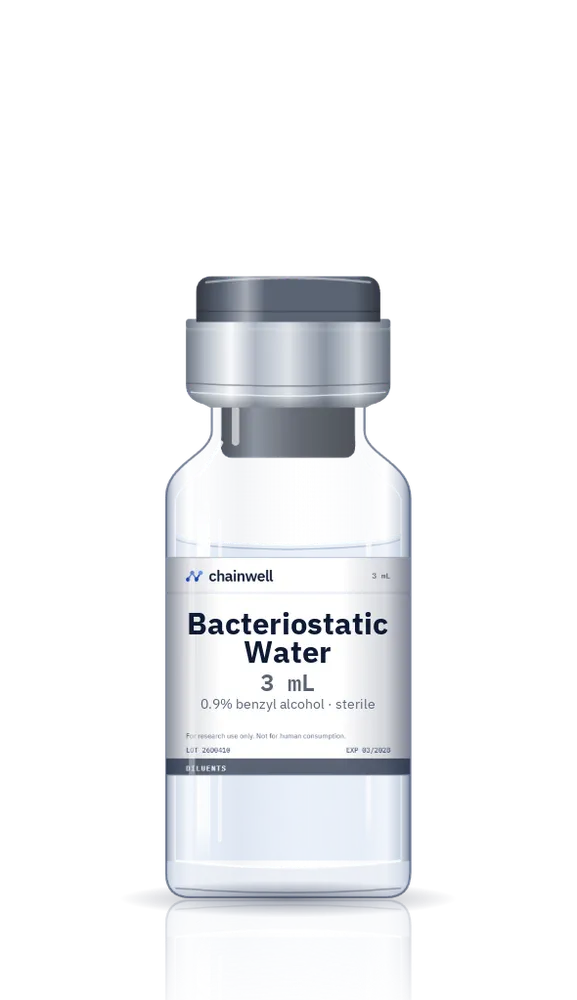
For a first order, the GHK-Cu Starter Kit packs a 50mg GHK-Cu vial, a 3 mL bacteriostatic water vial and a U-100 insulin syringe in one carton. For work that combines GHK-Cu with other tissue repair peptides, KLOW blends GHK-Cu with KPV, BPC-157 and TB-500 in a single 80mg vial. Our advice is the same as for any blend: choose it only when your protocol already specifies that combination, and use separate vials when you need to measure each compound on its own. See the full range of skin and cellular research peptides.
Lab-Tested GHK-Cu With a COA for Every Lot
Every Chainwell Peptide GHK-Cu lot is sent to an independent laboratory before release. Identity is confirmed by mass spectrometry and purity is measured by HPLC, and a lot that does not meet specification is not sold. The lot number on your vial links it to that report on our COA lookup page, which you can check before you order. Our guide on how to read a certificate of analysis explains each result.
Buy GHK-Cu in Australia
Chainwell Peptide supplies GHK-Cu peptide in Australia to laboratories, universities and independent researchers, packed and dispatched from within Australia. Before you buy GHK-Cu from any supplier, check that the listing states the fill, that the vial carries a lot number and a certificate for that lot, and that the photos show a blue cake rather than a white one.
- Same-day dispatch on orders paid before 3pm on a business day.
- Australia-wide delivery to Sydney, Melbourne, Brisbane, Adelaide, Perth, Hobart, Darwin and regional addresses, by standard or express post.
- PayID or bank transfer, with your order number as the payment reference.
- Tracked orders you can follow on our order tracking page.
The current price for each size is shown at the top of this page, with GST included. See our shipping policy for delivery details.
GHK-Cu Specifications
| Compound | GHK-Cu (glycyl-L-histidyl-L-lysine copper complex) |
|---|---|
| Also known as | Copper peptide, copper tripeptide-1 |
| Class | Copper-binding tripeptide |
| Vial sizes | 50mg, 100mg |
| Form | Lyophilized (freeze-dried) powder, blue |
| Container | 3 mL clear glass vial, rubber stopper, blue flip-off cap |
| Label | Product, strength, lot number, expiry, research-use statement |
| Identity testing | Mass spectrometry, per lot |
| Purity testing | HPLC, per lot |
| Diluent | Bacteriostatic water, sold separately or in the starter kit |
| Storage | Minus 20 °C long term, 2 to 8 °C short term, protect from light |
| Shipping | Standard or express post, Australia-wide |
Storing GHK-Cu Peptide
Unopened GHK-Cu keeps longest frozen at minus 20 °C in its carton, away from light, or at 2 to 8 °C for work planned within a few weeks. Once reconstituted, refrigerate the vial and use it within 28 days. A solution that turns cloudy or loses its blue colour should not be used. Our peptide storage guide covers handling in more detail.
Research Use Only
GHK-Cu supplied as a research compound is not approved by the Therapeutic Goods Administration for any therapeutic use, and it is not a cosmetic product. Chainwell Peptide sells it strictly for laboratory and in vitro research. It is not for human or veterinary use, and we do not provide dosing advice. By ordering you agree to our terms and conditions and research use only statement.
GHK-Cu tools and guides
- GHK-Cu Dosage Calculator for 50mg and 100mg Vials: bac water, concentration and U-100 syringe units
- GHK-Cu Before and After: What the Copper Peptide Studies Actually Measured
- What Is GHK-Cu? The Copper Peptide Explained
- GHK-Cu Side Effects: What the Studies and Regulators Report
- GHK-Cu Serum and Copper Peptide Creams: What Is Actually in the Bottle
- Bacteriostatic Water vs Sterile Water: Which Diluent for Peptides?
- Glutathione for Skin: What Oral, Topical and IV Studies Found
GHK-Cu FAQ
What is GHK-Cu?
+
GHK-Cu is a copper peptide: the tripeptide glycyl-L-histidyl-L-lysine bound to a copper ion. It occurs naturally in human plasma and was identified in 1973. It is studied in research on collagen synthesis, wound healing and tissue remodelling. Chainwell Peptide supplies it as 50mg and 100mg lyophilized vials.
Is GHK-Cu the same as copper tripeptide-1?
+
Yes, it is the same molecule under a different name. Copper tripeptide-1 is the name used on cosmetic ingredient lists, where it appears at low concentrations in serums and creams. GHK-Cu is the name used in research. Our vials contain the pure lyophilized compound, not a cosmetic formula.
Should I buy GHK-Cu 50mg or 100mg?
+
Buy the 50mg vial for a first order, new research or method development, since it is easier to use within 28 days of reconstitution. Buy the 100mg vial if you already run GHK-Cu regularly: it costs less per milligram and keeps repeated work on a single lot and certificate.
How much bac water for 50mg GHK-Cu?
+
It depends on the concentration you need. Adding 2 mL of bacteriostatic water to a 50mg GHK-Cu vial gives 25mg per mL, and 2.5 mL gives 20mg per mL. Our reconstitution calculator works out other volumes. Store the reconstituted vial at 2 to 8 °C and use it within 28 days.
Where can I buy GHK-Cu in Australia?
+
You can buy GHK-Cu in Australia from Chainwell Peptide in 50mg and 100mg vials, or as the GHK-Cu Starter Kit. Every lot carries a lot number matched to an independent certificate of analysis, and orders paid before 3pm on a business day ship the same day by standard or express post.
Do you sell GHK-Cu serum or cream?
+
No. Chainwell Peptide sells GHK-Cu only as a lyophilized research powder in 50mg and 100mg vials. Serums and creams are cosmetic products that contain the peptide, listed as copper tripeptide-1, at low concentrations alongside other ingredients. Our GHK-Cu is supplied for laboratory research use only.