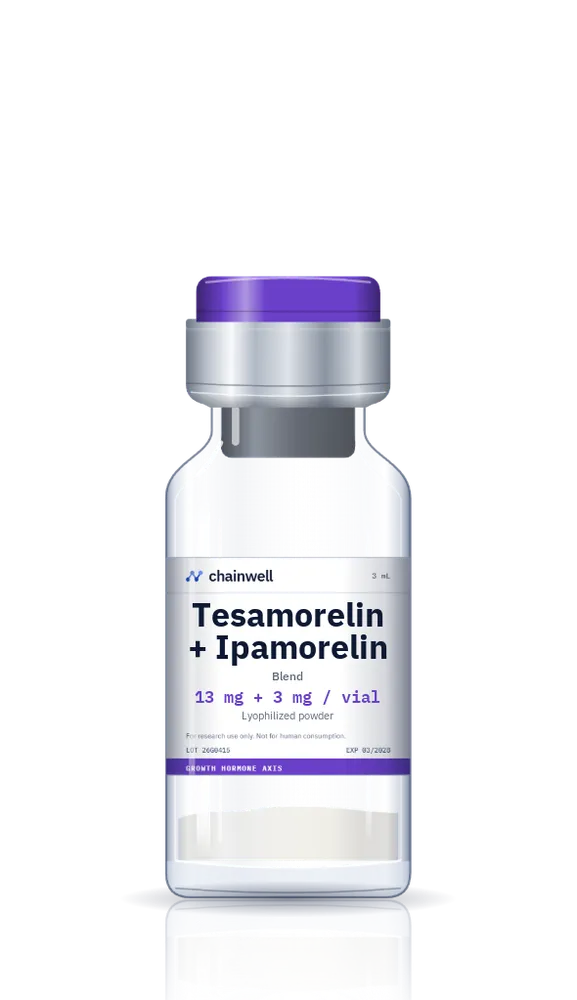
Two different compounds on two different receptors
Most searches for cjc 1295 side effects treat the blend as one drug. It is not. CJC-1295 is a growth hormone releasing hormone (GHRH) analogue that acts on the GHRH receptor in the anterior pituitary. Ipamorelin is a pentapeptide, Aib-His-D-2-Nal-D-Phe-Lys-NH2, that acts on the ghrelin receptor (GHS-R1a). They push growth hormone release through separate pathways, which is exactly why researchers pair them, and also why their side effect data have to be read separately.
CJC-1295 itself comes in two forms. The version tested in the human trials carries a Drug Affinity Complex (DAC), a reactive linker that bonds the peptide to circulating albumin and stretches its half-life to about a week. The version usually sold as "CJC-1295 No DAC" is modified GRF(1-29): the same 29-residue GHRH fragment with substitutions that resist enzyme breakdown, but no albumin anchor. We cover the chemistry in detail in our guide to CJC-1295 DAC vs No DAC; for side effects, the key point is that every published human trial used the DAC form.
CJC-1295 side effects in the published human trials
The main source is Teichman and colleagues, Journal of Clinical Endocrinology and Metabolism, 2006. It reported two randomised, placebo-controlled, double-blind, ascending-dose trials in healthy adults aged 21 to 61, lasting 28 and 49 days. A single injection raised mean GH two- to ten-fold for six days or more and IGF-1 1.5- to three-fold for 9 to 11 days. The estimated half-life of CJC-1295 was 5.8 to 8.1 days, and after repeated doses IGF-1 stayed above baseline for up to 28 days.
On safety, the authors reported no serious adverse reactions and described the compound as "relatively well tolerated", with the lower doses tolerated best. The adverse events summarised from that work by Healthy Male (the Australian men's health organisation) were injection-site reactions, headache, nausea and diarrhoea. Flushing and warmth after injection are also commonly described for GHRH analogues, consistent with a vasodilatory effect.
The second paper, Ionescu and Frohman (JCEM, 2006), looked at what continuous stimulation does to GH rhythm in healthy men aged 20 to 40. GH pulses kept their normal frequency and size, but trough GH rose 7.5-fold, mean GH rose 46 percent and IGF-1 rose 45 percent. That matters for side effect reasoning: CJC-1295 with DAC adds a raised floor of GH under the natural pulses rather than replacing them.
The last data point is the one most blog posts skip. ConjuChem's phase 2 trial in people with HIV-associated visceral obesity was halted in 2006 after a participant died of a heart attack shortly after an eleventh weekly dose. The treating physician judged the death unrelated to CJC-1295 and attributed it to undiagnosed coronary artery disease, but the programme did not go on to an approved medicine, and no larger human safety dataset exists.
Ipamorelin side effects: selectivity and the ileus trials
Ipamorelin's reputation for a "clean" side effect profile traces to one paper: Raun and colleagues at Novo Nordisk, European Journal of Endocrinology, 1998. In pigs, GHRP-6 and GHRP-2 raised ACTH and cortisol alongside GH. Ipamorelin did not, even at doses more than 200 times its GH-releasing ED50, and none of the secretagogues changed FSH, LH, prolactin or TSH. That selectivity is an animal finding, but it is why ipamorelin became the default ghrelin-receptor agonist in research designs where cortisol would confound results.
Human data come from gut research, not growth hormone research. After Venkova and colleagues (JPET, 2009) showed ipamorelin sped colonic transit in rats after abdominal surgery, Helsinn ran it as a postoperative ileus treatment. In the phase 2 trial published by Beck and colleagues (International Journal of Colorectal Disease, 2014), 117 bowel-resection patients received intravenous ipamorelin or placebo twice daily for up to seven days. Treatment-emergent adverse events occurred in 87.5 percent of the ipamorelin group and 94.8 percent of the placebo group, which reflects post-surgical patients rather than a drug signal. The authors called it well tolerated. Time to first tolerated meal was 25.3 hours versus 32.6 hours, but the difference was not significant, and a second, larger Helsinn phase 2 study was also completed without leading to an approved product.
So the honest summary of ipamorelin side effect data is short: tolerable by intravenous infusion in a hospital population over a week, with no long-term or subcutaneous safety study published.
CJC 1295 ipamorelin side effects: DAC vs No DAC
Because the human trials used DAC, their results do not transfer neatly to the No DAC form found in most blends. The DAC version keeps GH raised for days; modified GRF(1-29) produces a short pulse, closer in shape to native GHRH. Any cjc-1295 ipamorelin side effects discussion built on Teichman therefore describes a different exposure pattern from the one a No DAC blend produces.
| Compound | Receptor | Published human data | Key safety finding |
|---|---|---|---|
| CJC-1295 with DAC | GHRH receptor | Teichman 2006; Ionescu and Frohman 2006; halted HIV phase 2 | No serious adverse reactions in healthy adults; mild injection-site and GI events |
| CJC-1295 No DAC (mod GRF 1-29) | GHRH receptor | No dedicated published safety trial | Unknown; short exposure profile |
| Ipamorelin | Ghrelin receptor (GHS-R1a) | Beck 2014 ileus phase 2 (IV) | Well tolerated over 7 days; no ACTH or cortisol rise in animal work |
| CJC-1295 plus ipamorelin | Both | None | No combined human data at all |
Our view: for research on GH pulsatility, No DAC plus ipamorelin is the more controllable model, because both compounds clear quickly and washout periods stay short. CJC-1295 with DAC suits sustained-exposure designs, and it is the only form with human pharmacokinetics published. Researchers can compare fills on the CJC-1295 with DAC 5 mg vial and CJC-1295 No DAC product page.
CJC 1295 benefits and ipamorelin benefits: what was measured
The cjc 1295 benefits in the literature are hormone measurements: higher GH and IGF-1 in blood. In animals the picture goes further. Alba and colleagues (American Journal of Physiology, 2006) gave CJC-1295 to GHRH-knockout mice and found daily administration normalised body weight, length and body composition, with an increase in pituitary GH mRNA. Ipamorelin benefits are similarly preclinical: GH release in rats and pigs, and faster colonic transit in the rat ileus model.
What has not been shown is a clinical outcome in healthy people. Healthy Male puts it plainly: there is no good-quality human evidence that CJC-1295 or ipamorelin builds muscle, reduces fat, speeds recovery or slows ageing, and a change on a blood test is not the same as a health benefit. Tesamorelin is the contrast worth knowing. It is a GHRH analogue that did reach approval in the United States for HIV-associated abdominal fat, which is why the tesamorelin research peptide is often used as a comparator in GHRH studies.
The knowledge gaps that matter most
- No combination data. No published trial has given CJC-1295 and ipamorelin together to humans, so blend-specific side effects are undocumented.
- No long-term exposure data. The longest CJC-1295 trial ran 49 days. The effects of months of raised IGF-1 were not studied.
- No subcutaneous ipamorelin safety study. The human trials used intravenous infusion in hospital patients.
- Identity and purity risk. Unverified material can contain the wrong sequence, truncated fragments or residual solvents, which makes any observed effect uninterpretable.
The last gap is the one a supplier can close. Every Chainwell Peptide lot is tested by an independent laboratory for identity by mass spectrometry and purity by HPLC, and the lot number on each vial matches its certificate on our COA lookup page. If you are new to reading those reports, our walkthrough on how to read a certificate of analysis covers what the chromatogram and mass spectrum should show.
WADA status and the Australian position
The World Anti-Doping Agency Prohibited List names both compounds under S2.2.4, growth hormone releasing factors: CJC-1295 as a GHRH analogue and ipamorelin as a growth hormone secretagogue. They are prohibited at all times, in and out of competition. In Australia, neither is approved by the TGA for supply as a medicine, and neither appears on the ARTG as a registered product; check the current Poisons Standard for scheduling before any work outside a laboratory setting.
Chainwell Peptide supplies CJC-1295, ipamorelin and the blend strictly for in-vitro and laboratory research. They are not for human or veterinary use, and nothing on this page is dosing or treatment advice. For preparing solutions for lab work, the CJC-1295 and ipamorelin reconstitution calculator and the wider growth hormone peptide range are the next stops. Orders paid before 3pm AEST on a business day are dispatched the same day from within Australia.
Frequently asked questions
What are the most common CJC-1295 side effects in studies?
+
In the 2006 Teichman trials in healthy adults, CJC-1295 with DAC caused no serious adverse reactions. The adverse events reported were mild: injection-site reactions, headache, nausea and diarrhoea, with vasodilatory flushing also described for GHRH analogues. These data come from trials of 28 and 49 days, so longer-term effects are unknown.
Does ipamorelin have fewer side effects than other GHRPs?
+
In animal work, yes. Raun and colleagues (1998) found ipamorelin did not raise ACTH or cortisol in pigs, unlike GHRP-6 and GHRP-2, even at doses over 200 times its GH-releasing ED50. Whether that selectivity holds in people has not been tested in a dedicated human study.
Are there studies on CJC 1295 ipamorelin side effects together?
+
No. No published human trial has combined CJC-1295 and ipamorelin. Side effect claims about the blend are extrapolated from separate data: the CJC-1295 DAC trials in healthy adults and the intravenous ipamorelin trials in surgical patients. Neither used the No DAC form found in most blends.
Is CJC-1295 banned in sport?
+
Yes. The WADA Prohibited List names CJC-1295 under S2.2.4 growth hormone releasing factors, and names ipamorelin in the same section as a growth hormone secretagogue. Both are prohibited at all times, in and out of competition, for athletes under the World Anti-Doping Code.
Do the side effects differ between CJC-1295 DAC and No DAC?
+
They probably differ, but only the DAC form has human data. DAC bonds to albumin and keeps GH raised for about a week, while No DAC produces a short pulse. Side effects linked to sustained GH and IGF-1 increases in the DAC trials may not apply to No DAC, which has no published safety trial.