
What Is IGF-1 LR3 Peptide?
IGF-1 LR3 is a synthetic analogue of insulin-like growth factor 1 (IGF-1), the 70 amino acid hormone that carries out much of growth hormone's work in the body. The full name, Long R3 IGF-1, describes its two changes. "R3" means the glutamic acid at position 3 is replaced with arginine. "Long" means a 13 amino acid extension has been added to the start of the chain. The result is an 83 amino acid peptide with a molecular weight of about 9.1 kDa.
Both changes serve one purpose: keeping the peptide free and active. Natural IGF-1 is mostly bound in serum by a family of IGF binding proteins (IGFBPs), which hold it in reserve. IGF-1 LR3 binds those proteins only weakly, so far more of it stays available to act on the IGF-1 receptor.
Why LR3: IGF Binding Proteins
This is the property that made IGF-1 LR3 a laboratory staple. Cells in culture secrete their own IGF binding proteins, which soak up natural IGF-1 and blunt its effect. Because IGF-1 LR3 largely escapes them, it is reported to be several times more potent than native IGF-1 in cell culture, and it lasts longer in the medium. That is why it became a standard supplement in serum-free cell culture media, including in large-scale biomanufacturing.
Researchers use IGF 1 LR3 to study IGF-1 receptor signalling, cell proliferation and protein synthesis in culture. Browse the papers in our IGF-1 LR3 research library.
An Australian Peptide: Long R3 IGF-1 and Adelaide
IGF-1 LR3 has a local history. Long R3 IGF-1 was developed by researchers in Adelaide and commercialised by the Adelaide company GroPep as a cell culture reagent. Few research peptides sold in Australia can claim an Australian origin; this one can.
IGF-1 DES vs LR3
IGF-1 DES (des(1-3) IGF-1) is the other common IGF-1 variant. It takes the opposite approach: instead of adding amino acids, it removes the first three, which also reduces binding to IGFBPs. The practical difference is duration. IGF-1 DES is shorter and acts over a shorter window, while IGF-1 LR3, with its extension, is longer-lasting. We stock IGF-1 LR3.
IGF-1 LR3 vs CJC-1295 and Ipamorelin
IGF-1 LR3 is sometimes compared with CJC-1295, ipamorelin or growth hormone itself, but they work at different points in the same chain. CJC-1295 and ipamorelin act upstream, prompting the pituitary to release growth hormone; growth hormone then drives the liver to produce IGF-1. IGF-1 LR3 skips those steps and acts directly on the IGF-1 receptor.
| IGF-1 LR3 | CJC-1295 + ipamorelin | |
|---|---|---|
| Acts on | IGF-1 receptor, directly | Pituitary GHRH and ghrelin receptors |
| Position in the GH axis | Downstream | Upstream |
| Research amounts | Micrograms | Milligrams |
| Chainwell vial | 1mg | 10mg blend |
Our view: the choice depends on which step of the axis your study examines. To study GH release and its regulation, use a secretagogue; to study IGF-1 receptor signalling directly, use IGF-1 LR3. See all growth hormone research peptides.
IGF-1 LR3 1mg Vial
We supply IGF-1 LR3 as a 1mg lyophilized vial, a much smaller fill than our other peptides, because IGF-1 LR3 is potent and research amounts are measured in micrograms rather than milligrams. A 1mg vial holds 1,000 micrograms. The cake is correspondingly small, so do not be surprised if the vial looks nearly empty on arrival; the certificate of analysis confirms what is inside.
Acetic Acid or Bacteriostatic Water? Reconstituting IGF-1 LR3
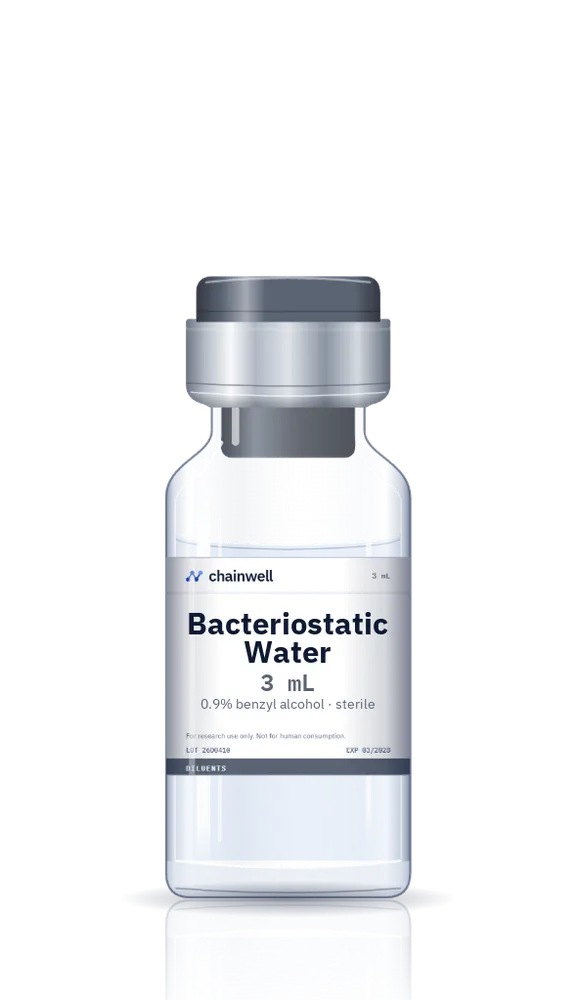
The diluent is where IGF-1 LR3 differs from most peptides. Many labs reconstitute it in dilute acid rather than water, because IGF-1 LR3 dissolves and stays in solution more readily at a slightly acidic pH. Our 0.6% acetic acid is supplied for exactly this use, and some protocols then dilute the acidic stock further with bacteriostatic water. Follow the method your protocol specifies.
As a worked example, 1 mL of diluent in the 1mg vial gives 1mg, or 1,000 micrograms, per mL. Add the diluent slowly down the inside wall with a U-100 insulin syringe and swirl gently; do not shake. Does IGF-1 LR3 need to be refrigerated? Yes: keep it at 2 to 8 °C once reconstituted, protected from light, and use it within 28 days. Unopened, it keeps longest frozen at minus 20 °C. Our reconstitution guide and calculator covers other volumes.
IGF-1 LR3 Capsules
We do not sell IGF-1 LR3 capsules, and we would be cautious of anyone who does. IGF-1 LR3 is an 83 amino acid protein, and like other proteins of its size it would be broken down by digestive enzymes, so there is no established basis for an oral format. It is supplied as a lyophilized vial.
Receptor Grade IGF-1 LR3 and Lab Testing
You will see IGF-1 LR3 sold as "receptor grade". The term has no fixed standard; what actually tells you about a vial is its certificate of analysis. Every Chainwell Peptide IGF-1 LR3 lot is sent to an independent laboratory before release, where mass spectrometry confirms the molecular mass matches IGF-1 LR3 and HPLC measures purity. A lot that does not meet specification is not sold. Check your lot on our COA lookup page, and see our guide on how to read a certificate of analysis.
Buy IGF-1 LR3 in Australia
Chainwell Peptide supplies IGF-1 LR3 for sale in Australia to laboratories, universities and independent researchers, packed and dispatched from within Australia. The best IGF-1 LR3 suppliers make three things easy to check: the fill in micrograms or milligrams, a lot number on the vial, and a lot-matched certificate you can see before you pay.
- Same-day dispatch on orders paid before 3pm on a business day.
- Australia-wide delivery to Sydney, Melbourne, Brisbane, Adelaide, Perth, Hobart, Darwin and regional addresses, by standard or express post.
- PayID or bank transfer, with your order number as the payment reference.
- Tracked orders you can follow on our order tracking page.
The current price is shown at the top of this page, with GST included. Add acetic acid 0.6% to your order if you are reconstituting in dilute acid. See our shipping policy for delivery details.
IGF-1 LR3 Specifications
| Compound | IGF-1 LR3 (Long R3 IGF-1) |
|---|---|
| Class | Insulin-like growth factor 1 analogue |
| Length | 83 amino acids (IGF-1 with a 13 amino acid N-terminal extension) |
| Modification | Arginine in place of glutamic acid at position 3 (R3) |
| Molecular weight | Approximately 9.1 kDa |
| Fill | 1mg (1,000mcg) per vial |
| Form | Lyophilized (freeze-dried) powder |
| Container | 3 mL clear glass vial, rubber stopper, purple flip-off cap |
| Diluent | 0.6% acetic acid or bacteriostatic water, sold separately |
| Identity and purity | Mass spectrometry and HPLC, per lot |
| Storage | Minus 20 °C long term, 2 to 8 °C once reconstituted, protect from light |
| Shipping | Standard or express post, Australia-wide |
Research Use Only
IGF-1 LR3 is not approved by the Therapeutic Goods Administration for any therapeutic use. Chainwell Peptide sells it strictly for laboratory and in vitro research. It is not for human or veterinary use, and we do not provide dosing advice. IGF-1 and its analogues are on the World Anti-Doping Agency prohibited list. By ordering you agree to our terms and conditions and research use only statement.
IGF-1 LR3 FAQ
What is IGF-1 LR3?
+
IGF-1 LR3, or Long R3 IGF-1, is an 83 amino acid analogue of insulin-like growth factor 1 with an arginine substitution at position 3 and a 13 amino acid extension. These changes let it largely escape IGF binding proteins, making it more potent in cell culture. Chainwell Peptide supplies it as a 1mg vial.
What does LR3 stand for?
+
LR3 stands for Long R3. "Long" refers to the 13 amino acid extension added to the start of the IGF-1 chain, and "R3" to the arginine (R) that replaces glutamic acid at position 3. Together they reduce binding to IGF binding proteins.
Should IGF-1 LR3 be mixed with acetic acid or bacteriostatic water?
+
Many labs reconstitute IGF-1 LR3 in 0.6% acetic acid, because it dissolves and stays in solution more readily at a slightly acidic pH, and some then dilute with bacteriostatic water. Chainwell Peptide stocks both. Follow the method your research protocol specifies.
Does IGF-1 LR3 need to be refrigerated?
+
Yes. Once reconstituted, keep IGF-1 LR3 at 2 to 8 °C, protected from light, and use it within 28 days. Unopened lyophilized vials keep longest frozen at minus 20 °C, and we ship every order by standard or express post.
What is the difference between IGF-1 LR3 and CJC-1295?
+
They act at different points of the growth hormone axis. CJC-1295 prompts the pituitary to release growth hormone, which then raises IGF-1. IGF-1 LR3 acts directly on the IGF-1 receptor, skipping those steps. Use a secretagogue to study GH release, and IGF-1 LR3 to study IGF-1 signalling.
Where can I buy IGF-1 LR3 in Australia?
+
You can buy IGF-1 LR3 in Australia from Chainwell Peptide as a 1mg lyophilized vial, with 0.6% acetic acid available for reconstitution. Every lot carries a lot number matched to an independent certificate of analysis, and orders paid before 3pm on a business day ship the same day.