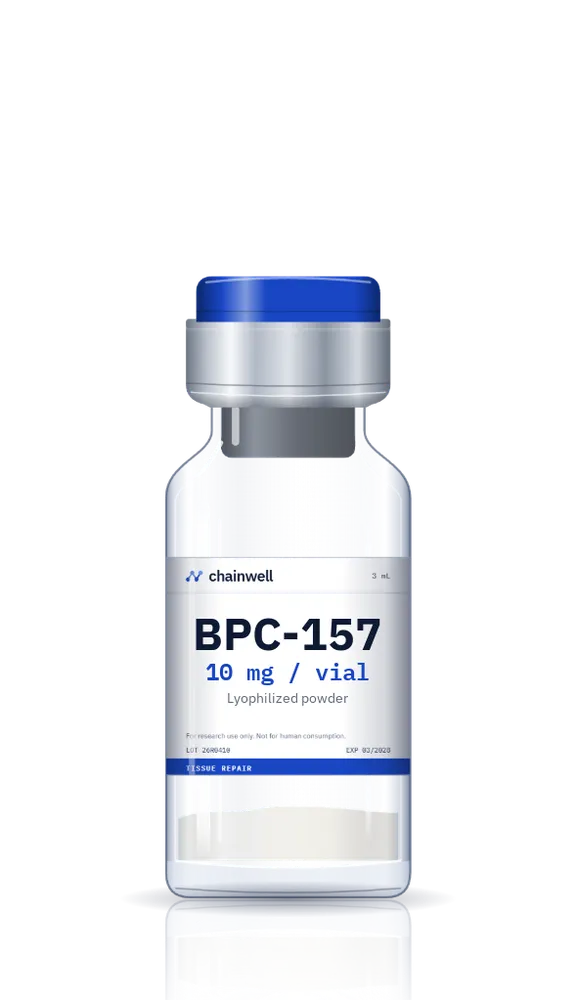
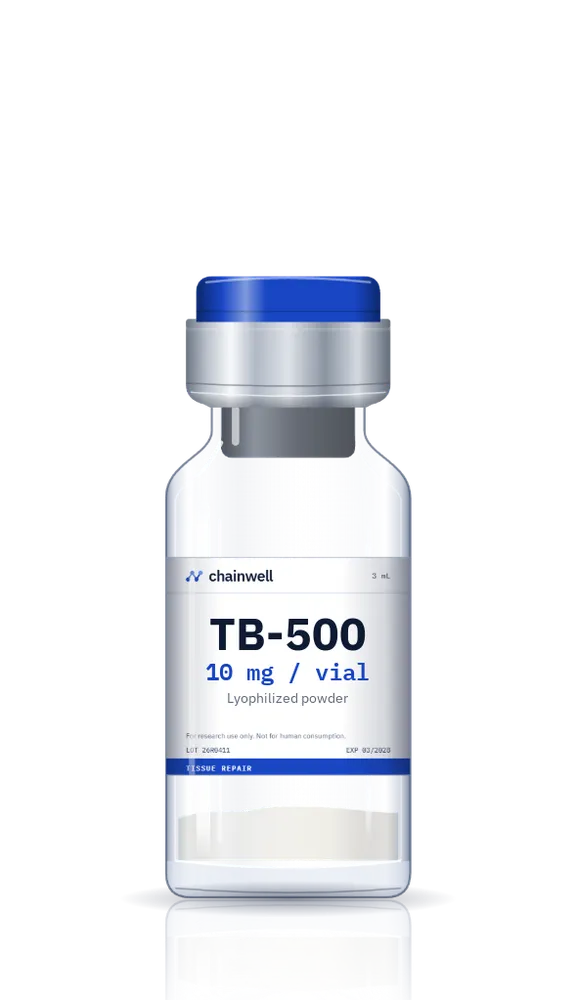
BPC 157 vs TB500 side by side
| BPC-157 | TB-500 | |
|---|---|---|
| Parent protein | Body protection compound in human gastric juice | Thymosin beta-4, present in almost every cell |
| Discovered by | Sikiric group, University of Zagreb, early 1990s | Tβ4 isolated by Goldstein group from calf thymus |
| Sequence | GEPPPGKPADDAGLV | Ac-LKKTETQ (Tβ4 residues 17 to 23) |
| Length and mass | 15 amino acids, about 1419 Da | 7 amino acids, about 889 Da |
| Main proposed mechanism | VEGFR2 and Akt-eNOS signalling, nitric oxide system, FAK-paxillin in fibroblasts | G-actin binding, cell migration, angiogenesis |
| Research areas | Tendon, ligament, gut, vascular endothelium | Wound closure, cardiac models, eye surface (full Tβ4) |
| Stable in gastric juice | Yes, per published studies | Not established |
| Human data | Three small uncontrolled reports | None for the fragment; phase 1 to 3 for full Tβ4 |
| WADA | S0, Non-Approved Substances | S2, peptide hormones and growth factors |
| Chainwell Peptide formats | BPC-157 10 mg vial and 500 mcg capsules | TB-500 10 mg vial |
Different origins, different questions
Read any BPC 157 vs TB 500 thread and the two are treated as a pair, but they have nothing in common structurally. BPC-157 was built from a gastric protein by a group interested in why the stomach lining survives its own acid, and its literature grew outward from ulcers into tendon, ligament and blood vessel models. Staresinic and colleagues (Journal of Orthopaedic Research, 2003) on rat Achilles tendon and Chang and colleagues (Journal of Applied Physiology, 2011) on tendon fibroblasts are the papers most cited on the musculoskeletal side. More background is in our guide to what BPC-157 is.
TB-500 comes from the opposite direction: a cytoskeletal protein, thymosin beta-4, whose actin-binding motif was cut out and synthesised on its own. Its research case rests largely on full-length Tβ4 studies, such as the 2004 Nature paper on mouse heart cells, which is a gap our TB-500 explainer covers in detail.
TB 500 vs BPC 157: mechanism
Put simply, TB-500 is studied for getting cells to the injury and BPC-157 for what happens to the tissue and its blood supply once they arrive. Tβ4 regulates the pool of free G-actin, and cells cannot migrate without remodelling actin. BPC-157 has been shown to up-regulate VEGFR2 (Hsieh and colleagues, Journal of Molecular Medicine, 2017), interact with the nitric oxide system, and increase fibroblast outgrowth and migration through FAK and paxillin.
Both, notably, are pro-angiogenic in models. That overlap is part of why they are paired, and it is also the shared theoretical concern around long-term safety that our BPC-157 safety review discusses.
Formats: why BPC-157 comes in capsules and TB-500 does not
The most practical difference between tb500 vs bpc 157 is format. BPC-157 is described in the literature as stable in gastric juice, so it is one of the few peptides studied orally, and Chainwell Peptide supplies it as 500 mcg capsules as well as a 10 mg vial. TB-500 has no established gastric stability, so we supply it only as a lyophilized 10 mg vial. Both vials are 3 mL glass with a rubber stopper, reconstituted with bacteriostatic water, and both have a calculator: the BPC-157 calculator and the TB-500 calculator.
Separate vials or the Wolverine blend?
This is the decision that matters for ordering, and our recommendation has not changed: if your study compares BPC-157 and TB-500, or might need to change one without the other, order separate vials. Once two peptides are lyophilized together, the ratio is fixed and you cannot measure either compound in isolation.
Order the Wolverine Blend (BPC-157 + TB-500) only when a protocol already specifies the two together at a fixed ratio. It then halves the vials, reconstitutions and lot numbers to track, and one certificate covers both peptides. The BPC-157 and TB-500 blend calculator handles the combined 10 mg fill.
| Separate vials | Wolverine blend | |
|---|---|---|
| Vials to reconstitute | Two | One |
| Ratio | Set by you | Fixed at manufacture |
| Certificates | One per compound | One covering both |
| Best for | Comparison and dose-response work | Protocols that already combine both |
Where KLOW and GLOW fit
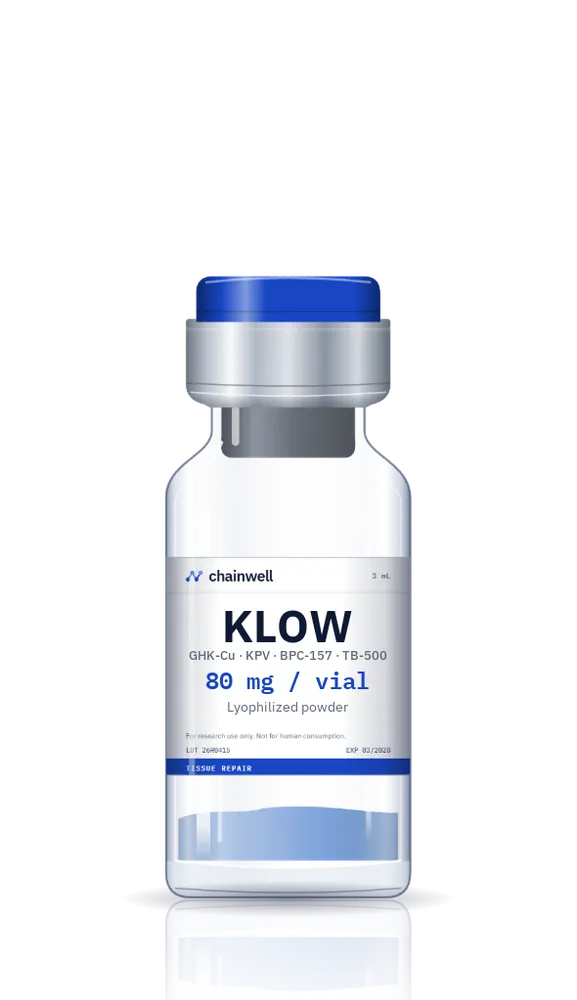
Two larger blends build on the same pair. GLOW is a 70 mg vial holding 50 mg GHK-Cu with 10 mg each of BPC-157 and TB-500, so the copper peptide makes up most of the fill. KLOW is an 80 mg vial that adds KPV, the lysine-proline-valine tripeptide, to those three. Both are blue because of the GHK-Cu.
The same logic applies as with the Wolverine blend, only more so: four compounds in one vial means four ratios you cannot change. KLOW and GLOW suit research that already uses those exact combinations. If you only need the two tissue repair peptides, the Wolverine blend or separate vials are the cleaner choice. The GLOW vs KLOW guide compares the two larger blends.
Legal status and research use
Neither peptide is an approved medicine in Australia or on the ARTG. BPC-157 has been a Schedule 4 substance under the Poisons Standard since 1 June 2024; our BPC-157 legal status guide sets out what we verified. Every Chainwell Peptide lot of all five products on this page is tested by an independent laboratory for identity and purity, and the whole tissue repair research range ships from within Australia. All are sold for laboratory research only, not for human or veterinary use, and we do not give dosing or stacking advice.
Frequently asked questions
What is the difference between BPC 157 and TB 500?
+
BPC-157 is a 15 amino acid fragment of a gastric juice protein, studied for VEGFR2, nitric oxide and fibroblast signalling in tendon and gut models. TB-500 is a seven amino acid fragment of thymosin beta-4, studied for actin binding and cell migration. They share no sequence and come from unrelated proteins.
Is TB 500 or BPC 157 better?
+
Neither is better in general; they are studied for different mechanisms. BPC-157 has the larger direct literature and is stable in gastric juice. TB-500 borrows most of its evidence from full thymosin beta-4 research. The right choice depends on the pathway a study is designed to test.
Should I order separate vials or the Wolverine blend?
+
Order separate vials if your study compares BPC-157 and TB-500 or may need to adjust one independently, because a blend fixes the ratio. Choose the Wolverine blend only when your protocol already uses both at a set ratio, which saves a vial and a reconstitution.
What is the difference between the Wolverine blend and KLOW?
+
The Wolverine blend contains only BPC-157 and TB-500 in a 10 mg vial. KLOW is an 80 mg vial that adds GHK-Cu and KPV to those two, and GLOW is a 70 mg vial of GHK-Cu, BPC-157 and TB-500 without KPV.