Thymosin beta-4, the parent protein
Thymosin beta-4 (Tβ4) was isolated from calf thymus by Allan Goldstein's group, which gave it the "thymosin" name, but it turned out to be everywhere: in nearly all nucleated cells, and at especially high levels in platelets and white blood cells. It has 43 amino acids, an acetylated N-terminus and a molecular weight of about 4963 Da.
Its day job is actin sequestration. Tβ4 binds single actin molecules (G-actin) and holds them in reserve, controlling how fast a cell can assemble the filaments that let it change shape and move. That is why it is studied in cell migration, wound closure and blood vessel growth: all three depend on cells moving to the right place.
What is TB 500 exactly? The Ac-LKKTETQ fragment
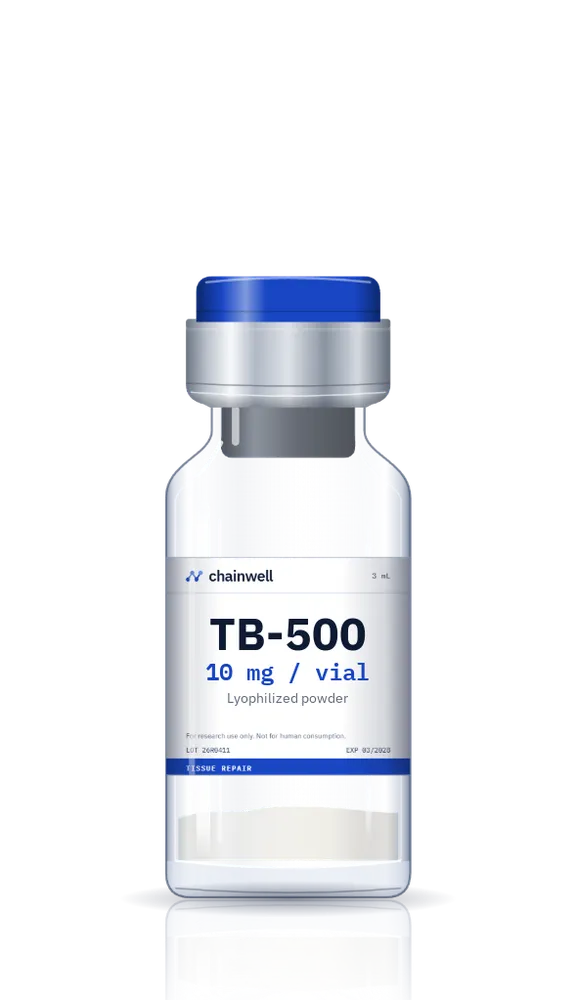
The TB-500 peptide in the research market is generally the sequence Leu-Lys-Lys-Thr-Glu-Thr-Gln, residues 17 to 23 of Tβ4, with an acetyl group on the N-terminus: Ac-LKKTETQ. That stretch is the central actin-binding motif, and the idea behind TB-500 is to keep the part of the protein thought to drive actin binding and cell migration, in a molecule small enough to synthesise cheaply. It weighs roughly 889 Da, about a fifth of the full protein.
The name is used loosely, though, and some listings described as "TB-500" or "TB -500 peptide" are really full-length thymosin beta-4. The mass on a certificate of analysis tells you which you have: around 889 Da for the fragment, around 4963 Da for the full protein. Chainwell Peptide lots are identity-tested by mass spectrometry at an independent laboratory, and you can check a lot on the COA lookup page.
TB-500 vs full thymosin beta-4
| TB-500 | Thymosin beta-4 | |
|---|---|---|
| Length | 7 amino acids (Ac-LKKTETQ) | 43 amino acids |
| Molecular weight | About 889 Da | About 4963 Da |
| Origin | Synthetic fragment, residues 17 to 23 | Natural protein, synthesised or recombinant for study |
| Human trials | None published | Phase 1 to 3 trials, including eye drops (RGN-259) |
| WADA | Prohibited, S2 | Prohibited, S2 |
This is the key point most TB-500 pages skip. The famous studies (Malinda and colleagues on rat wound closure in the Journal of Investigative Dermatology, 1999; Bock-Marquette and colleagues on cardiac cell survival in mice in Nature, 2004) used full thymosin beta-4. Whether a seven-residue fragment reproduces those effects has not been shown to the same standard. Our view: treat TB-500 as its own compound with a borrowed literature, and design studies that test the fragment directly rather than assuming equivalence.
TB 500 benefits: what the research covers
The reported TB 500 benefits are really the research areas of Tβ4 biology:
- Cell migration and wound closure. Tβ4 promoted keratinocyte and endothelial cell migration and faster wound closure in rats.
- Angiogenesis. Tβ4 supports new blood vessel formation, a step in any repair process.
- Cardiac models. The 2004 Nature study reported activation of survival signalling (integrin-linked kinase and Akt) in mouse heart cells after injury.
- Eye surface repair. Full Tβ4 as the eye drop RGN-259 reached phase 3 for dry eye (ARISE-3), where co-primary endpoints were missed but some symptom measures improved, and it was studied in neurotrophic keratopathy.
None of these results are for the Ac-LKKTETQ fragment in people. What does TB 500 do in a person? Nobody has published a trial that could say.
TB 500 side effects: the knowledge gaps
There is no published human safety study of TB-500 the fragment, so a list of TB-500 side effects cannot be written honestly. The nearest data are for the full protein. Ruff and colleagues (Annals of the New York Academy of Sciences, 2010) gave intravenous synthetic Tβ4 to healthy volunteers in single doses from 42 to 1260 mg and then daily for 14 days; adverse events were infrequent and mild to moderate, with no dose-limiting toxicity. A first-in-human phase 1 study of recombinant Tβ4 in healthy Chinese volunteers was published in the Journal of Cellular and Molecular Medicine in 2021.
The theoretical concern mirrors BPC-157's. Tβ4 drives cell migration and angiogenesis, and in cancer biology high Tβ4 expression has been associated with invasion and metastasis, for example in a 2004 study of SW480 colon carcinoma cells and in later colorectal tumour series. That is an association with the body's own Tβ4 in tumours, not evidence that TB-500 causes cancer, but it is the reason long-term safety cannot be assumed. Product quality is the other risk: the TGA named TB-500 in its April 2026 warning about unapproved peptide products, citing contamination and mislabelling in vials sold online.
WADA status
Thymosin beta-4 and its derivatives, including TB-500, are on the WADA Prohibited List under S2 (peptide hormones, growth factors, related substances and mimetics), banned in and out of competition. BPC-157 sits separately under S0; our BPC-157 side effects review covers that compound.
TB-500 alongside BPC-157
TB-500 is most often studied next to BPC-157, the gastric pentadecapeptide, because the two are thought to act through different routes: actin and cell migration for TB-500, growth factor and nitric oxide signalling for BPC-157. Our side-by-side comparison of BPC-157 and TB-500 sets out when separate vials make sense and when the Wolverine Blend does. The TB-500 reconstitution calculator works out concentration for the 10 mg vial.
TB-500 sits in our tissue repair peptide category. It is sold for laboratory research only, not for human or veterinary use, and it is not approved by the TGA for any therapeutic use.
Frequently asked questions
What is TB 500?
+
TB-500 is a synthetic peptide of seven amino acids, Ac-LKKTETQ, matching residues 17 to 23 of thymosin beta-4. That region is the protein's central actin-binding motif. It is studied in research on cell migration, wound healing and blood vessel growth, and it is not an approved medicine.
Is TB-500 the same as thymosin beta-4?
+
No. Thymosin beta-4 is the full 43 amino acid protein (about 4963 Da); TB-500 is a seven-residue fragment of it (about 889 Da). Most published studies used the full protein, so check the molecular weight on a certificate of analysis to confirm which one you have.
What are the side effects of TB 500?
+
No human safety study of the TB-500 fragment has been published. For full thymosin beta-4, a 2010 phase 1 trial reported infrequent, mild to moderate adverse events. The open concerns are theoretical, linked to its roles in cell migration and angiogenesis, and practical, such as contamination in unverified products.
What are the benefits of TB 500?
+
The claimed benefits come from studies of full thymosin beta-4 in animals and cells: faster wound closure, cell migration, angiogenesis and cardiac cell survival. Whether the TB-500 fragment reproduces these effects has not been shown in controlled human trials.
Is TB-500 banned in sport?
+
Yes. Thymosin beta-4 and derivatives such as TB-500 are prohibited under S2 of the WADA Prohibited List, in and out of competition.