Does Chainwell Peptide Sell a Glutathione Supplement?
No. Chainwell Peptide does not sell glutathione tablets, pills, capsules, liposomal liquids or any product meant to be swallowed. The only glutathione we supply is a lyophilized vial of reduced L-glutathione for laboratory research. We wrote this page because a large number of people searching for a glutathione supplement end up on research supplier sites, and the honest answer is that a research vial is a different product for a different buyer.
What follows is a factual comparison of the supplement formats and what the absorption studies found, then a short section on what a research reagent is for. We do not recommend any supplement brand or dose. For the chemistry of the molecule, start with our explainer on what glutathione is.
Glutathione Supplement Formats: Tablets, Pills, Liposomal and Precursors
Glutathione is a tripeptide of glutamate, cysteine and glycine, and every cell makes its own. Supplements try to raise it in one of four ways:
- Glutathione tablets and capsules. Plain reduced glutathione (GSH), sold as L-glutathione pills. The L refers to the natural form; it is the same molecule.
- Liposomal glutathione. Glutathione enclosed in phospholipid vesicles, usually as a liquid or soft capsule, on the theory that the lipid shell protects it from digestion.
- Sublingual or orobuccal forms. Tablets or lozenges designed to be absorbed through the lining of the mouth rather than the gut.
- Precursors. N-acetylcysteine (NAC) and glycine, which supply the building blocks cells use to make their own glutathione.
The phrase "glutathione food supplement" comes mainly from Europe, where EU Directive 2002/46/EC defines food supplements as foodstuffs that supplement the normal diet, are concentrated sources of nutrients or other substances with a nutritional or physiological effect, and are sold in dose form such as capsules, tablets, pills and measured liquids. Australia classifies most of these products differently, as covered below.
Does Oral Glutathione Get Absorbed? What the Studies Found
The central problem is digestion. Glutathione is a peptide, and the small intestine is lined with enzymes, notably gamma-glutamyltransferase, that break peptides into amino acids. The early human data looked bad for plain tablets:
- Witschi and colleagues (European Journal of Clinical Pharmacology, 1992) gave seven healthy volunteers a single oral dose of 0.15 mmol/kg. Plasma glutathione, cysteine and glutamate did not rise significantly over the following 270 minutes, and the authors concluded that systemic availability was negligible.
- Allen and Bradley (Journal of Alternative and Complementary Medicine, 2011) randomised 40 healthy adults to 500 mg twice daily or placebo for four weeks and found no significant change in glutathione status or oxidative stress biomarkers.
- Richie and colleagues (European Journal of Nutrition, 2015) ran a longer test: a six-month, double-blind, placebo-controlled trial in 54 non-smoking adults at 250 or 1,000 mg a day. Blood glutathione rose at both amounts. At six months the higher amount showed increases of 30 to 35% in erythrocytes, plasma and lymphocytes and 260% in buccal cells, and natural killer cell cytotoxicity more than doubled against placebo at three months. Levels returned to baseline after a one-month washout.
The fairest reading is that single doses and short trials show little, while one well-run six-month trial found a gradual rise in body stores that disappeared when intake stopped. Whether that happens because some intact glutathione is absorbed or because its amino acids feed the body's own synthesis is not settled by these studies.
Sublingual delivery has one comparative trial. Schmitt and colleagues (Redox Biology, 2015) ran a three-week crossover in 20 adults with metabolic syndrome comparing 450 mg a day of oral GSH, the same amount sublingually, and 200 mg a day of NAC. The sublingual form raised plasma total and reduced glutathione significantly more than the oral tablet, which produced a non-significant fall, and gave the best GSH to GSSG ratio at the end of the study.
Liposomal Glutathione: The Claimed Benefits and the Evidence
Liposomal glutathione is marketed as the answer to the absorption problem. The human evidence is one small study. Sinha and colleagues (European Journal of Clinical Nutrition, 2018), also from Penn State researchers, gave 12 healthy adults liposomal glutathione at 500 or 1,000 mg a day for one month. Glutathione rose within a week, with maximum increases after two weeks of 40% in whole blood, 25% in erythrocytes, 28% in plasma and 100% in peripheral blood mononuclear cells. Plasma 8-isoprostane, an oxidative stress marker, fell 35%, and natural killer cell cytotoxicity rose by up to 400%.
Those numbers are what liposomal glutathione benefits claims usually rest on, so the limits matter. It was a pilot of 12 people over four weeks, the abstract describes no placebo group, and the authors themselves reported no difference between the two dose groups while noting that statistical power was limited. Our view: liposomal delivery is a reasonable idea with encouraging pilot data, but the claim that it is proven superior to plain tablets outruns the evidence. No head-to-head trial of liposomal against standard oral glutathione appears in the studies above.
Precursors: N-Acetylcysteine and Glycine
The precursor approach skips glutathione altogether and supplies what cells need to make it. Cysteine is generally considered the limiting building block, which is why NAC, a stable cysteine source, is the classic precursor.
The key study is Sekhar and colleagues (American Journal of Clinical Nutrition, 2011). Using stable isotope infusions, they found that older adults aged 60 to 75 had lower red cell glutathione concentrations and synthesis rates than younger controls. After 14 days of cysteine (given as N-acetylcysteine) plus glycine in eight older participants, red cell glutathione concentration rose 94.6%, its fractional synthesis rate 78.8% and its absolute synthesis rate 230.9%, while plasma oxidative stress markers fell to levels comparable to the young group.
Two cautions. The study was tiny, and it was designed around people with a measured deficiency; it does not show that precursors raise glutathione in young, healthy people who already make enough. In the Schmitt crossover above, NAC at 200 mg a day did not outperform sublingual glutathione.
Glutathione Supplement Formats Compared
| Format | What it contains | Key human study | What was found | Main limitation |
|---|---|---|---|---|
| Tablets, capsules, pills | Reduced L-glutathione | Richie et al., 2015; Allen and Bradley, 2011 | Rise in body stores over months in one trial; no change over four weeks in another | Broken down by gut enzymes; effect reversed after stopping |
| Liposomal | Glutathione in phospholipid vesicles | Sinha et al., 2018 | Blood and immune cell GSH up within two weeks | 12 subjects, one month, no placebo arm described |
| Sublingual | Glutathione tablet held in the mouth | Schmitt et al., 2015 | Plasma GSH up more than with oral tablets | 20 subjects, three weeks per arm |
| Precursors | N-acetylcysteine plus glycine | Sekhar et al., 2011 | Synthesis and red cell GSH restored in older adults | 8 treated subjects, deficiency population only |
| Research vial (not a supplement) | Lyophilized reduced glutathione | Laboratory use only | Known mass and purity per lot | Not for human consumption |
Safety across routes, including why nebulised and injected glutathione carry very different risks from oral forms, is covered in our review of glutathione side effects.
How Glutathione Supplements Are Regulated in Australia
In Australia a glutathione supplement is a therapeutic good, and most sit in the lowest-risk tier: listed medicines, which carry an AUST L number on the label. The TGA's own description of this tier is worth reading closely:
- Listed medicines are not individually evaluated by the TGA for quality, safety or efficacy before they go on sale. They enter the Australian Register of Therapeutic Goods (ARTG) after the sponsor certifies that the product meets the legislative requirements.
- They may contain only low-risk ingredients from the Permissible Ingredients Determination, and may use only low-level health claims chosen from a list of permitted indications.
- Under section 26A of the Therapeutic Goods Act 1989, the sponsor must hold evidence supporting those indications at the time of listing. The TGA runs random and targeted post-market compliance reviews and can cancel non-compliant products from the ARTG.
- AUST L(A) (assessed listed) and AUST R (registered) products sit above this tier and are evaluated before supply.
At the time of writing, the ARTG search on the TGA website returns many glutathione products, including liposomal liquids and sublingual tablets from several sponsors. That is why people searching for glutathione supplements at Chemist Warehouse or liposomal glutathione in Australia find a wide range on pharmacy shelves. An AUST L number tells you the product is legally supplied; it does not mean the TGA has evaluated whether it works. Listed medicines also cannot claim to whiten skin, a point covered in what the glutathione skin studies found. For a personal decision about any supplement, a pharmacist or doctor is the right person to ask.
Where a Research-Grade Glutathione Vial Fits
Reduced glutathione is one of the most used reagents in redox biology: an antioxidant control in cell culture oxidative stress models, a substrate in glutathione S-transferase and glutathione peroxidase assays, and a reducing agent in protein refolding buffers. For that work a lab needs a known mass of GSH with verified identity, not a capsule blended with fillers, flow agents and a liposome shell.
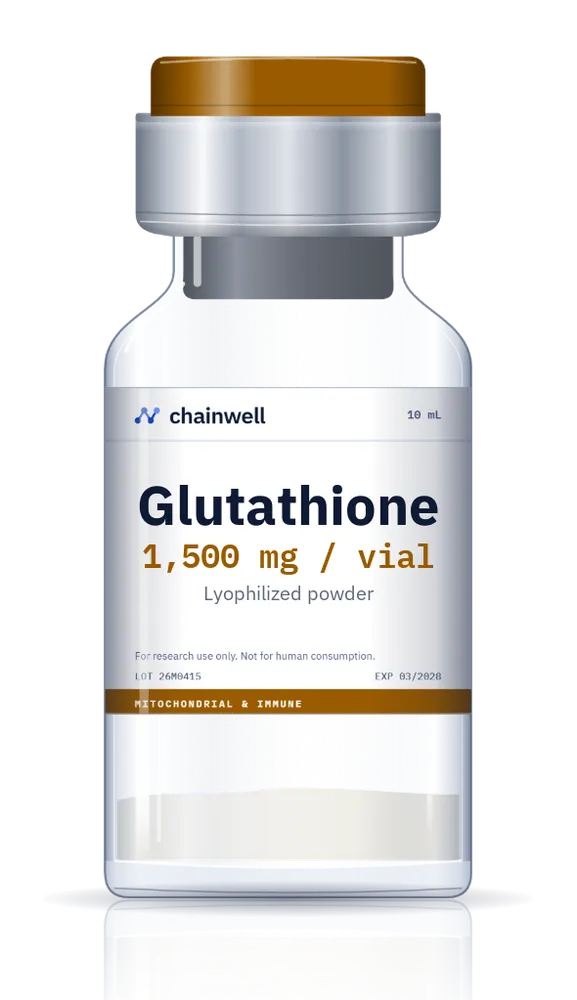
Our 1,500 mg reduced glutathione vial is filled in a 10 mL vial because of the large mass. Each lot is tested by an independent laboratory for identity by mass spectrometry and purity by HPLC, and the lot number on the vial matches its certificate on the certificate of analysis lookup. Our guide to reading a COA line by line explains what a pass looks like. Store the sealed vial frozen at minus 20 °C; in solution, GSH gradually oxidises to GSSG, so prepared solutions should be refrigerated and used promptly, as covered in the peptide storage guide.
Labs studying oxidative stress often pair glutathione with mitochondrial compounds such as NAD+ and the SS-31 peptide; the wider range is in our mitochondrial research compounds. Orders paid before 3pm AEST on a business day are dispatched the same day from within Australia by tracked post.
Chainwell Peptide sells glutathione for laboratory research use only. It is not a supplement, is not sterile, and is not for human or veterinary use; it must not be used to make capsules, drinks or any product for consumption.
Frequently asked questions
What is the best glutathione supplement?
+
We do not recommend any brand or dose, and Chainwell Peptide does not sell supplements. The evidence can help frame the choice: plain oral glutathione raised body stores gradually in one six-month trial, liposomal and sublingual forms have small positive studies, and NAC with glycine restored synthesis in older adults. In Australia, check for an AUST L number and ask a pharmacist.
Is liposomal glutathione better than glutathione tablets?
+
It has not been proven. The main liposomal study (Sinha, 2018) found blood glutathione rose up to 40% within two weeks, but it had 12 subjects, lasted one month and described no placebo group. We found no head-to-head trial comparing liposomal with standard oral glutathione, so claims of superiority go beyond the published data.
Does oral glutathione actually get absorbed?
+
Results conflict. A 1992 single-dose study and a four-week 2011 trial found no meaningful rise in glutathione, largely because gut enzymes break it down. A six-month 2015 trial found body stores rose 30 to 35% in blood compartments at 1,000 mg a day, returning to baseline one month after stopping.
Does Chainwell Peptide sell glutathione tablets or liposomal glutathione?
+
No. Chainwell Peptide does not sell glutathione tablets, pills, capsules, liposomal products or any supplement. We supply reduced L-glutathione only as a 1,500 mg lyophilized vial for laboratory research, tested for identity and purity with a lot-matched certificate. It is not for human consumption.
What are glutathione supplement benefits in studies?
+
Controlled human studies mostly measured glutathione levels and oxidative stress markers rather than health outcomes. The six-month Richie trial reported higher body stores and more than doubled natural killer cell activity at three months. Evidence for broader benefits is limited, and in Australia listed medicines may only make low-level permitted claims.