What is glutathione, chemically? L-glutathione explained
Glutathione is gamma-L-glutamyl-L-cysteinyl-glycine, formula C10H17N3O6S, molecular weight about 307.3 g/mol. "L-glutathione" and "glutathione" name the same molecule: the L refers to the natural configuration of its amino acids, and it is the only form that matters biologically.
The detail that makes glutathione unusual is its first bond. Glutamate is attached to cysteine through its side-chain (gamma) carboxyl group rather than the usual alpha carboxyl. Ordinary peptidases do not recognise that bond, so glutathione survives inside cells at high concentration; only the enzyme gamma-glutamyl transpeptidase, on the outer surface of cells, breaks it down. The working part of the molecule is the thiol (-SH) group on cysteine, which donates electrons and binds to reactive compounds.
Cells make glutathione in two ATP-dependent steps. Glutamate-cysteine ligase joins glutamate and cysteine into gamma-glutamylcysteine, the rate-limiting step, and glutathione synthetase then adds glycine. Cysteine availability usually limits how much gets made, which is why cysteine donors such as N-acetylcysteine appear so often in glutathione research.
Reduced glutathione (GSH) vs oxidised glutathione (GSSG)
When two glutathione molecules give up electrons, their thiols join into a disulfide bond and form GSSG, oxidised glutathione (molecular weight about 612.6 g/mol). The enzyme glutathione reductase converts GSSG back to two GSH molecules using NADPH, so the pool cycles rather than being used up.
| GSH (reduced) | GSSG (oxidised) | |
|---|---|---|
| Structure | Single tripeptide with a free thiol | Two tripeptides linked by a disulfide |
| Role | Electron donor, conjugation partner | Product of oxidation, recycled by glutathione reductase |
| Share in resting cells | The large majority | A small fraction |
| Research use | Antioxidant controls, enzyme substrate | Oxidised standard, redox buffer studies |
In healthy resting cells the GSH to GSSG ratio in the cytosol typically exceeds 100 to 1; under oxidative stress it can fall to 10 to 1 or lower. That is why the ratio is a common readout in oxidative stress research. When people search "reduced glutathione benefits", they are asking about GSH, the form our research vial contains.
What does glutathione do in the body?
Glutathione is for what, in plain terms? Its roles in cell biology fall into a few well-established groups:
- Antioxidant defence. Glutathione peroxidases, a family of selenium-containing enzymes, use GSH to reduce hydrogen peroxide and lipid peroxides to water and alcohols. GSH also regenerates vitamins C and E after they neutralise radicals.
- Detoxification. Glutathione S-transferases attach GSH to reactive electrophiles, drug metabolites and pollutants, making them water-soluble for excretion. The best-known example is paracetamol: in overdose, its reactive metabolite NAPQI exhausts liver glutathione, which is why N-acetylcysteine, a cysteine donor, is the standard antidote.
- Redox signalling. Proteins can be reversibly S-glutathionylated on cysteine residues, a modification that protects them from irreversible oxidation and switches their activity.
- Other roles. Storage and transport of cysteine, maintenance of mitochondrial redox state, and involvement in immune cell function are all documented research areas.
Glutathione benefits: what the research has actually tested
"Glutathione benefits" is one of the most searched phrases around this molecule, and most of what appears online overstates the evidence. The better question is what controlled studies have measured.
Can oral glutathione raise body levels? Results conflict. Allen and Bradley (Journal of Alternative and Complementary Medicine, 2011) gave 500 mg twice daily for four weeks and found no change in GSH, GSSG or their ratio. Richie and colleagues (European Journal of Nutrition, 2015) ran a longer six-month randomised trial in 54 adults at 250 or 1,000 mg a day and reported rises in blood glutathione at both doses; at six months the high-dose group's levels were 30 to 35% higher in erythrocytes, plasma and lymphocytes and about 260% higher in buccal cells. Duration and dose appear to matter.
Skin. Small trials of oral and topical glutathione found modest, temporary reductions in melanin index. We cover these in detail in glutathione for skin: what the studies found.
What these studies do not show is that glutathione treats or prevents disease in healthy people. Low glutathione is associated with many conditions in observational research, but association is not evidence that adding glutathione changes outcomes. Tolerability data from the trials, and regulator warnings about injectable use, are in our glutathione side effects guide.
Glutathione in the laboratory
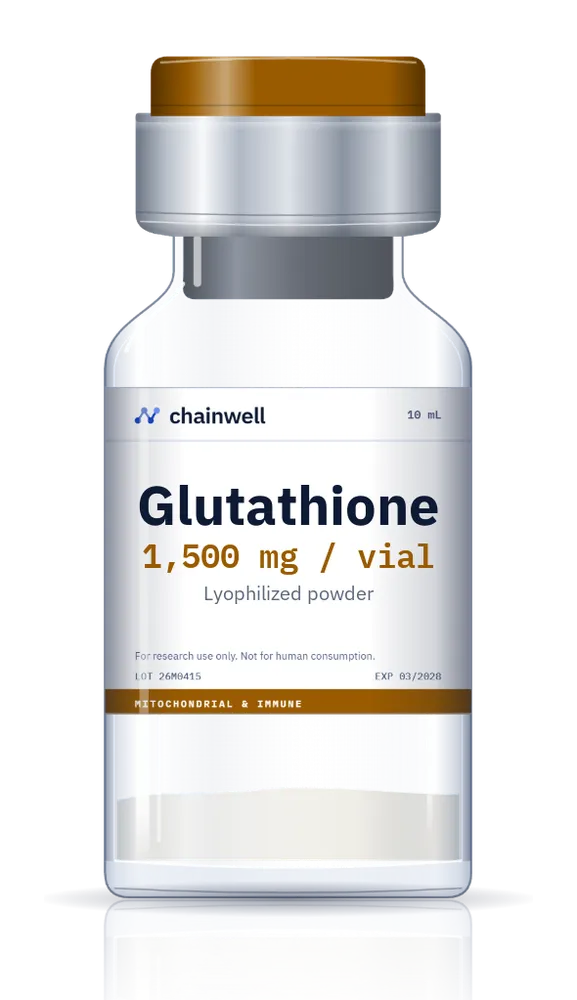
Reduced glutathione is a standard bench reagent: an antioxidant control in cell culture, a substrate for glutathione S-transferase and peroxidase assays, a reducing agent in protein refolding buffers, and a reference compound in oxidative stress models. Chainwell Peptide supplies reduced L-glutathione as a 1,500 mg lyophilized vial, filled in a 10 mL vial because of the large mass. Every lot is tested by an independent laboratory for identity by mass spectrometry and purity by HPLC, and the lot number on the vial matches its certificate on our COA lookup page.
Two handling points specific to glutathione. It dissolves in water only to roughly 50 to 100 mg per mL, so the full fill will not go into solution at full strength inside the vial. And GSH in solution slowly oxidises to GSSG, so prepare only what a run needs, keep it at 2 to 8 °C and protect it from light. Our reconstitution guide covers technique, and bacteriostatic water or your method's buffer can be used as the solvent.
Researchers working on skin biology often study glutathione alongside copper peptides in our skin and cellular peptides category. Chainwell Peptide sells glutathione for laboratory research use only. It is not a supplement or a medicine, and it is not for human or veterinary use.
Frequently asked questions
What is glutathione in simple terms?
+
Glutathione is a small molecule made from three amino acids, glutamate, cysteine and glycine, that cells produce themselves. It is the main small antioxidant inside cells and helps enzymes neutralise peroxides and attach to toxic compounds so they can be removed. It is one of the most studied molecules in oxidative stress research.
What is L-glutathione, and is it different from glutathione?
+
L-glutathione and glutathione are the same molecule. The L describes the natural configuration of the amino acids it is built from. Labels use either name, and supplements, research reagents and the glutathione in your cells are all the L form.
What are the benefits of reduced glutathione?
+
In research terms, reduced glutathione (GSH) is the active, electron-donating form used by glutathione peroxidases and S-transferases. Clinical studies of supplementation give mixed results: one six-month trial found higher blood glutathione, another four-week trial found no change, and skin studies showed modest temporary effects. None establishes a treatment benefit in healthy people.
What does glutathione do for the liver?
+
The liver has high glutathione levels and uses it to conjugate and clear reactive compounds. In paracetamol overdose, the toxic metabolite NAPQI depletes liver glutathione, which is why N-acetylcysteine, which supplies cysteine for glutathione synthesis, is the standard antidote.
What is the difference between GSH and GSSG?
+
GSH is reduced glutathione, a single tripeptide with a free thiol group. GSSG is oxidised glutathione, two molecules joined by a disulfide bond after donating electrons. Glutathione reductase converts GSSG back to GSH using NADPH, and the GSH to GSSG ratio is a common marker of oxidative stress.