
What Is Glutathione?
Glutathione is a tripeptide, three amino acids long: glutamate, cysteine and glycine. What makes it unusual among peptides is how the first two are joined. The glutamate is linked through its side chain, forming what chemists call a gamma bond, rather than through the backbone as in almost every other peptide. That gamma bond protects glutathione from the enzymes that break down ordinary peptides, which is part of why cells can maintain it at such high concentrations.
The working part of the molecule is the cysteine, whose sulfur-containing thiol group can donate electrons to neutralise reactive molecules. Almost every cell makes its own glutathione, and it is present at millimolar concentrations inside cells, making it the most abundant small thiol antioxidant in the body.
Glutathione and L-Glutathione: The Same Molecule
One of the most common questions is the difference between glutathione and L-glutathione. There isn't one. Amino acids come in two mirror-image forms, L and D, and the amino acids in living things are the L form. L-glutathione simply names the natural form explicitly; glutathione, L-glutathione and glutathione L all refer to the same compound.
The distinction that does matter is reduced versus oxidised. Reduced glutathione (GSH) is the active form, with its thiol group free. When it neutralises a reactive molecule, two glutathione molecules join through a disulfide bond to form oxidised glutathione (GSSG). The ratio of GSH to GSSG is one of the most widely used markers of oxidative stress in research. Our vial contains reduced L-glutathione.
What Does Glutathione Do? Glutathione Research
Glutathione is one of the most studied molecules in cell biology. Research uses it in three main ways:
- Antioxidant defence. Glutathione is the substrate for glutathione peroxidases, the enzymes that break down hydrogen peroxide and lipid peroxides.
- Detoxification. Glutathione S-transferases attach glutathione to a wide range of compounds so cells can clear them, a central pathway in drug and toxin metabolism research.
- Redox signalling. The balance between reduced and oxidised glutathione influences how proteins are switched on and off, making it a tool for studying cell signalling under stress.
Glutathione is also closely tied to mitochondrial research, since mitochondria produce much of the cell's oxidative load. It pairs naturally with NAD+, another central molecule of cellular metabolism, and with SS-31, which targets oxidative damage at the mitochondrial membrane. Browse the published work in our glutathione research library.
Glutathione in Food
Glutathione is present in many foods, particularly fresh vegetables and fruits such as asparagus, avocado and spinach, and the body also makes it from the amino acids cysteine, glutamate and glycine. How much dietary or oral glutathione reaches the blood intact is debated in the research literature, since the gut breaks down much of it. For laboratory work, that question does not arise: a defined, lot-tested reagent gives you a known quantity of reduced glutathione to work with.
Glutathione 1,500mg Vial
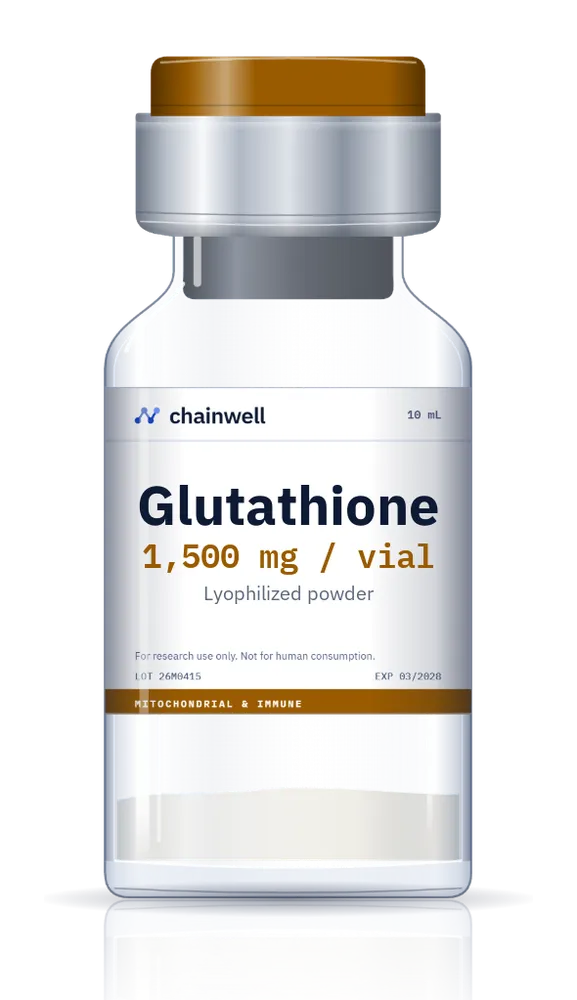
Chainwell Peptide supplies glutathione as a 1,500mg lyophilized vial. Because the fill is so much larger than a typical peptide vial, it comes in a 10 mL clear glass vial rather than our 3 mL format, with a rubber stopper and an amber flip-off cap, the colour we use across our skin and cellular research compounds. At about 307 g/mol, 1,500mg is roughly 4.9 millimoles of glutathione.
1,500mg is a large mass for a 10 mL vial, and reduced glutathione dissolves in water only up to roughly 50 to 100mg per mL, so the whole fill will not dissolve at full strength in the vial itself. Dissolve it in a volume that suits your protocol, using bacteriostatic water or the buffer your method specifies, and transfer to a larger sterile container if you need more than the vial holds. Reduced glutathione in solution gradually oxidises to GSSG, so keep the reconstituted vial at 2 to 8 °C, protected from light, and use it within 28 days; unopened, it keeps longest frozen at minus 20 °C. Our reconstitution guide and calculator covers other volumes.
A Research Reagent, Not a Supplement or Injection
Most glutathione sold in Australia is a consumer product: supplements, liposomal liquids, skin creams, or injections and IV drips offered by clinics. Our glutathione is none of those. It is a lyophilized research reagent, supplied with a lot-matched certificate for laboratory use, and it is not a supplement, a cosmetic or an injectable product for people.
Lab-Tested Glutathione With a COA for Every Lot
For glutathione, purity testing also shows how much of the material is still in the active reduced form rather than oxidised to GSSG. Every Chainwell Peptide glutathione lot is sent to an independent laboratory before release: identity is confirmed by mass spectrometry and purity is measured by HPLC. A lot that does not meet specification is not sold. Check your lot on our COA lookup page, and see our guide on how to read a certificate of analysis.
Buy Glutathione in Australia
Chainwell Peptide supplies research-grade glutathione in Australia to laboratories, universities and independent researchers, packed and dispatched from within Australia. Before you buy glutathione for research from any supplier, check that the listing states the form (reduced or oxidised), the fill, and that a lot-matched certificate is available before you pay.
- Same-day dispatch on orders paid before 3pm on a business day.
- Australia-wide delivery to Sydney, Melbourne, Brisbane, Adelaide, Perth, Hobart, Darwin and regional addresses, by standard or express post.
- PayID or bank transfer, with your order number as the payment reference.
- Tracked orders you can follow on our order tracking page.
The current price is shown at the top of this page, with GST included. See our shipping policy for delivery details.
Glutathione Specifications
| Compound | Glutathione, reduced (GSH), L-form |
|---|---|
| Class | Tripeptide antioxidant (gamma-glutamyl-cysteinyl-glycine) |
| Sequence | gamma-Glu-Cys-Gly |
| Molecular formula | C10H17N3O6S |
| Molecular weight | Approximately 307.3 g/mol |
| Fill | 1,500mg per vial |
| Form | Lyophilized (freeze-dried) powder |
| Container | 10 mL clear glass vial, rubber stopper, amber flip-off cap |
| Identity and purity | Mass spectrometry and HPLC, per lot |
| Storage | Minus 20 °C long term, 2 to 8 °C once reconstituted, protect from light |
| Shipping | Standard or express post, Australia-wide |
Research Use Only
This glutathione is supplied as a laboratory reagent. It is not a therapeutic good, a complementary medicine or a cosmetic, and it is not for human or veterinary use. Chainwell Peptide sells it strictly for laboratory and in vitro research, and we do not provide dosing advice. By ordering you agree to our terms and conditions and research use only statement.
Glutathione tools and guides
Glutathione FAQ
What is glutathione?
+
Glutathione is a tripeptide of glutamate, cysteine and glycine, joined by an unusual gamma bond that protects it from breakdown. It is the most abundant small antioxidant molecule inside cells. Chainwell Peptide supplies reduced L-glutathione as a 1,500mg lyophilized research vial.
What is the difference between glutathione and L-glutathione?
+
There is none. L-glutathione names the natural L form of the amino acids explicitly, and glutathione, L-glutathione and glutathione L all mean the same compound. The distinction that matters is reduced (GSH) versus oxidised (GSSG); our vial contains reduced glutathione.
What does glutathione do?
+
In cells, glutathione neutralises reactive molecules through its cysteine thiol group, feeds antioxidant enzymes such as glutathione peroxidase, and is attached to compounds by glutathione S-transferases so they can be cleared. Research uses it to study oxidative stress and redox signalling.
Is this glutathione a supplement or injection?
+
No. Chainwell Peptide glutathione is a lyophilized laboratory reagent with a lot-matched certificate of analysis. It is not a supplement, cosmetic or injectable product for people, and it is sold strictly for research use.
How do you reconstitute glutathione 1,500mg?
+
Reduced glutathione dissolves in water only up to roughly 50 to 100mg per mL, so 1,500mg will not dissolve completely in the 10 mL vial. Use a volume suited to your protocol, transferring to a larger sterile container if needed. Store the solution at 2 to 8 °C and use it within 28 days.
Where can I buy glutathione for research in Australia?
+
You can buy research-grade glutathione in Australia from Chainwell Peptide as a 1,500mg lyophilized vial. Every lot carries a lot number matched to an independent certificate of analysis, and orders paid before 3pm on a business day ship the same day.