What is MOTS-c?
MOTS-c stands for mitochondrial open reading frame of the 12S rRNA type-c. It is a 16-amino-acid peptide, MRWQEMGYIFYPRKLR, encoded not in the cell nucleus but in the mitochondrial genome, inside the gene for 12S ribosomal RNA. It was reported by Changhan Lee, Pinchas Cohen and colleagues at the University of Southern California in Cell Metabolism in 2015, and it was the second mitochondrial-derived peptide described after humanin.
That origin is why researchers find it so interesting. Mitochondria were long treated as power plants that take orders from the nucleus. MOTS-c was early evidence that they also send hormone-like signals of their own, and a small, well-defined sequence makes it practical to synthesise and study.
How MOTS-c works: the folate cycle and AMPK
The 2015 paper found skeletal muscle to be the main target. Inside cells, MOTS-c inhibits the folate cycle and the de novo purine synthesis tied to it. That causes a build-up of AICAR, an intermediate that activates AMP-activated protein kinase (AMPK), the cell's main energy-stress sensor. AMPK activation increases glucose uptake and fatty acid use, which links MOTS-c to the same pathway many exercise and metformin studies point to.
A follow-up paper, Kim and colleagues (Cell Metabolism, 2018), showed that under metabolic stress such as glucose restriction, MOTS-c moves into the nucleus in an AMPK-dependent way and regulates nuclear genes, including antioxidant-response genes controlled by NRF2. A peptide made by mitochondria that directly adjusts nuclear gene expression is the finding that made the field take notice.
MOTS-c benefits reported in animal studies
Almost all the mots-c peptide benefits quoted online come from two mouse papers.
- Lee et al., Cell Metabolism, 2015. MOTS-c treatment prevented high-fat-diet-induced obesity and insulin resistance, and reversed age-dependent insulin resistance in muscle.
- Reynolds et al., Nature Communications, 2021. MOTS-c improved physical performance in young (2 month), middle-aged (12 month) and old (22 month) mice. Intermittent treatment started late in life, at 23.5 months, increased physical capacity and healthspan measures. The same paper found exercise raises MOTS-c levels in human skeletal muscle and blood.
That last point is the source of the "exercise mimetic" label. It is a fair description of what happened in mice. It is not evidence that giving MOTS-c reproduces exercise in people, and the gap between those two statements is where most MOTS-c marketing lives.
Human data: CB4211 and the first MOTS-c trial
The only completed human trial of a MOTS-c-based drug used CB4211, an analogue developed by CohBar with properties improved over the native peptide. In the phase 1b stage of a phase 1a/1b study (ClinicalTrials.gov NCT03998514), 20 obese people with nonalcoholic fatty liver disease received CB4211 or placebo by daily subcutaneous injection for four weeks. CohBar reported in 2021 that it was well tolerated with no serious adverse events, that ALT and AST fell by 25 and 17 percent relative to placebo, and that glucose fell, with a trend toward lower body weight. These were exploratory endpoints in a small, short study of a modified molecule.
Native MOTS-c entered its own trial in 2026. A phase 2a study sponsored by Hudson Biotech (NCT07505745), recruiting in China since February 2026, is randomising an estimated 120 adults with prediabetes and overweight or obesity to MOTS-c or placebo for 12 weeks, with insulin sensitivity (Matsuda index) and treatment-emergent adverse events as primary outcomes. At the time of writing, no results have been posted.
MOTS-c side effects and "before and after" claims
There is no published safety dataset for native MOTS-c in humans, so any list of mots-c side effects is guesswork. What can be said: CB4211 caused no serious adverse events in its short trial; the mouse studies did not report toxicity; and because MOTS-c acts through AMPK and glucose handling, blood glucose is the obvious variable a well-designed study would watch. Injection-site reactions are generic to any injected peptide. The Hudson Biotech trial is the first that will measure adverse events for MOTS-c itself.
The same applies to mots-c before and after posts. No human study has published before and after body composition or performance data for MOTS-c. Photos and forum logs have no control group, no verified material and usually several other compounds in play. Our view: MOTS-c is one of the most scientifically interesting peptides on the market, and that is exactly why it deserves to be studied with verified material and proper controls rather than sold on transformation pictures.
Working with MOTS-c in the lab
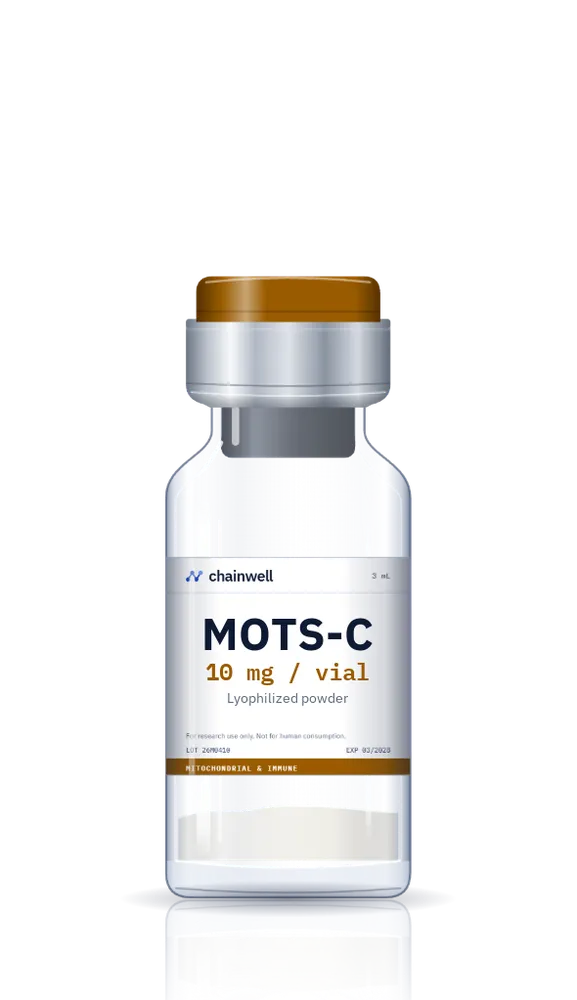
Chainwell Peptide supplies MOTS-c as 10 mg and 40 mg lyophilised vials. The larger fill suits longer protocols where one lot across the whole study keeps variables fixed. Like most lyophilised peptides, it is best stored frozen or refrigerated, away from light; see our peptide storage guide for the detail and the MOTS-c reconstitution calculator for concentration maths.
Researchers building mitochondrial models often run MOTS-c alongside SS-31, the cardiolipin-targeting peptide, or NAD+ for redox and sirtuin work. The small molecule SLU-PP-332 targets a different exercise pathway, the estrogen-related receptors, and is explained in our SLU-PP-332 explainer. The full mitochondrial research range groups them together.
All of these are sold for laboratory research only, not for human or veterinary use, and nothing on this page is dosing advice. Every vial carries a lot number that matches its certificate on the certificate of analysis lookup, and orders paid before 3pm AEST on a business day are dispatched the same day from within Australia.
Frequently asked questions
What is MOTS-c?
+
MOTS-c is a 16-amino-acid peptide (MRWQEMGYIFYPRKLR) encoded in the mitochondrial genome, within the 12S rRNA gene. It was described by Lee and colleagues in Cell Metabolism in 2015. It acts mainly on skeletal muscle, activating AMPK through effects on the folate cycle, and is studied for metabolic regulation.
What are the MOTS-c peptide benefits in humans?
+
They have not been established. The benefits reported so far, including protection from diet-induced obesity and insulin resistance and better physical performance, come from mouse studies. The analogue CB4211 lowered liver enzymes in a four-week trial in 20 people, and a phase 2a MOTS-c trial began in 2026.
What are the known MOTS-c side effects?
+
No published human safety data exist for native MOTS-c. The analogue CB4211 was well tolerated with no serious adverse events over four weeks. Mouse studies did not report toxicity. Because MOTS-c affects glucose handling through AMPK, glucose changes are the main theoretical concern researchers would monitor.
Are there MOTS-c before and after results?
+
Not from controlled research. No human study has published before and after data for MOTS-c. Mouse studies show improved treadmill performance and less weight gain on a high-fat diet, but online before and after photos lack controls, verified material and dose records, so they cannot be interpreted.
Is CB4211 the same as MOTS-c?
+
No. CB4211 is an analogue of MOTS-c developed by CohBar with modified properties. It is the compound used in the only completed human trial. Results from CB4211 cannot be assumed to apply to native MOTS-c, which is being tested separately in a phase 2a trial registered as NCT07505745.