
What Is MOTS-c Peptide?
MOTS-c stands for mitochondrial open reading frame of the 12S rRNA type-c. It is a 16 amino acid peptide, and what makes it unusual is where its code lives: not in the nucleus, where almost all of the body's proteins are encoded, but in the small circle of DNA inside mitochondria, the cell's energy-producing compartments. That places it in a new class of molecules called mitochondrial-derived peptides.
MOTS-c was described in 2015 in the journal Cell Metabolism by Changhan Lee and colleagues at the University of Southern California. The name is often searched as MOT-C, MOT C or MOTS C; all refer to the same peptide, and our product is listed as MOTS-C.
What Does MOTS-c Do? MOTS-c Research
MOTS-c research has grown quickly since 2015. The main lines of work, almost all in cells and mice, are:
- Metabolic regulation and insulin sensitivity. The original study reported that MOTS-c acts mainly in skeletal muscle, activates AMPK, the cell's energy sensor, and prevented diet-induced obesity and insulin resistance in mice.
- A signal from mitochondria to the nucleus. Later work reported that under metabolic stress MOTS-c moves into the cell nucleus and influences the expression of genes involved in the stress response, making it a messenger between the two genomes.
- Exercise capacity and ageing. A 2021 study in Nature Communications reported that MOTS-c levels respond to exercise and that treatment improved physical performance in aged mice, which is why MOTS-c is often described as an exercise mimetic.
Searches for MOTS-c for energy reflect this energy-metabolism research rather than any established effect in people. Browse the papers, with links to each, in our MOTS-c research library.
MOTS-C 10mg and 40mg Vials
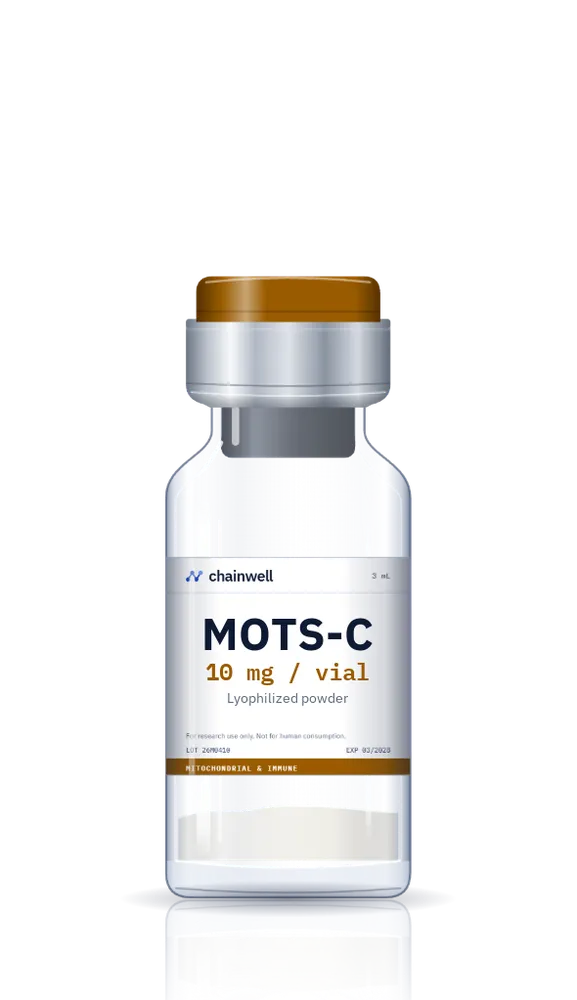
Chainwell Peptide stocks MOTS-C in two fills, both produced to the same specification and sealed in the same 3 mL glass vial with an amber flip-off cap, the colour we use across our mitochondrial research peptides. Choose the size that matches the scale of your study.
MOTS-C 10mg
The MOTS-c 10mg vial is the standard size and the one we recommend for a first order, method development or a short study. It is also the easiest fill to use completely inside the 28 day window after reconstitution, so little peptide is lost if a study pauses.
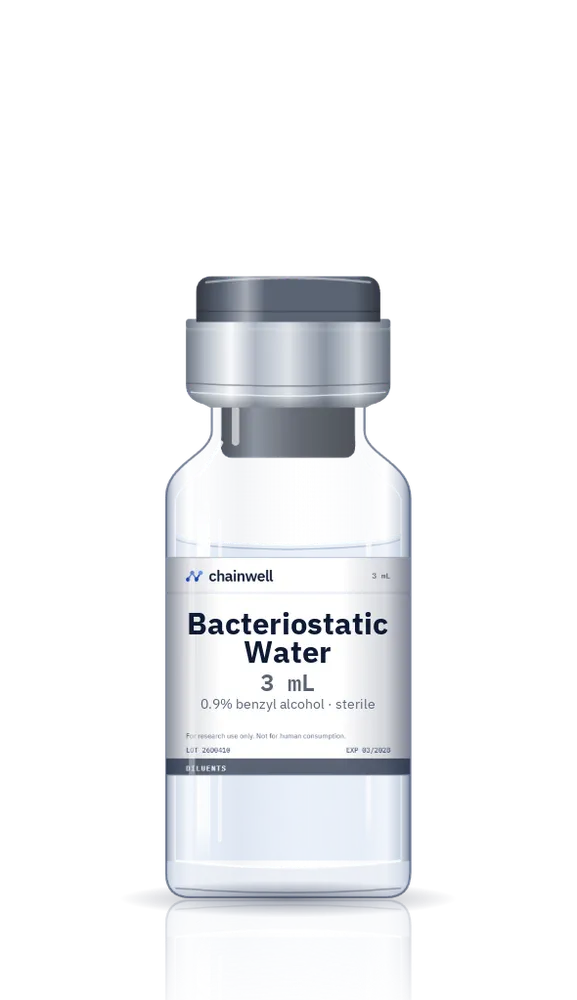
For MOTS-c reconstitution, 2 mL of bacteriostatic water in the 10mg vial gives 5mg per mL, and 1 mL gives 10mg per mL.
MOTS-C 40mg
MOTS-c 40mg holds four times the peptide of the 10mg vial in a single lot, so ongoing work runs from one certificate of analysis instead of four, and it costs less per milligram. It suits labs that already work with MOTS-c and have a settled method.
Because the vial holds so much peptide, the 40mg fill only makes sense when the reconstituted vial will be used within 28 days. As a worked example, 2 mL of bacteriostatic water gives 20mg per mL.
MOTS-c Reconstitution and Half-Life
To reconstitute MOTS-c, let the vial reach room temperature, wipe the stopper with an alcohol swab, and add bacteriostatic water slowly down the inside wall with a U-100 insulin syringe. Swirl gently until clear; do not shake. Keep the reconstituted vial at 2 to 8 °C, protected from light, and use it within 28 days. Our reconstitution guide and calculator works out any other volume.
Published data on the half-life of MOTS-c are limited. As a 16 amino acid peptide it is expected to be cleared relatively quickly, and research interest centres on its downstream effects on metabolic signalling and gene expression rather than on the peptide persisting.
MOTS-c With NAD+, SS-31 and Retatrutide
MOTS-c is often researched alongside other compounds that act on mitochondria or metabolism, but each works at a different level:
| MOTS-c | SS-31 | NAD+ | Retatrutide | |
|---|---|---|---|---|
| Type | 16 amino acid mitochondrial-derived peptide | Synthetic tetrapeptide | Coenzyme, not a peptide | Incretin receptor agonist peptide |
| Acts on | Metabolic signalling, AMPK, gene expression | Inner mitochondrial membrane (cardiolipin) | Energy metabolism, sirtuins | GIP, GLP-1 and glucagon receptors |
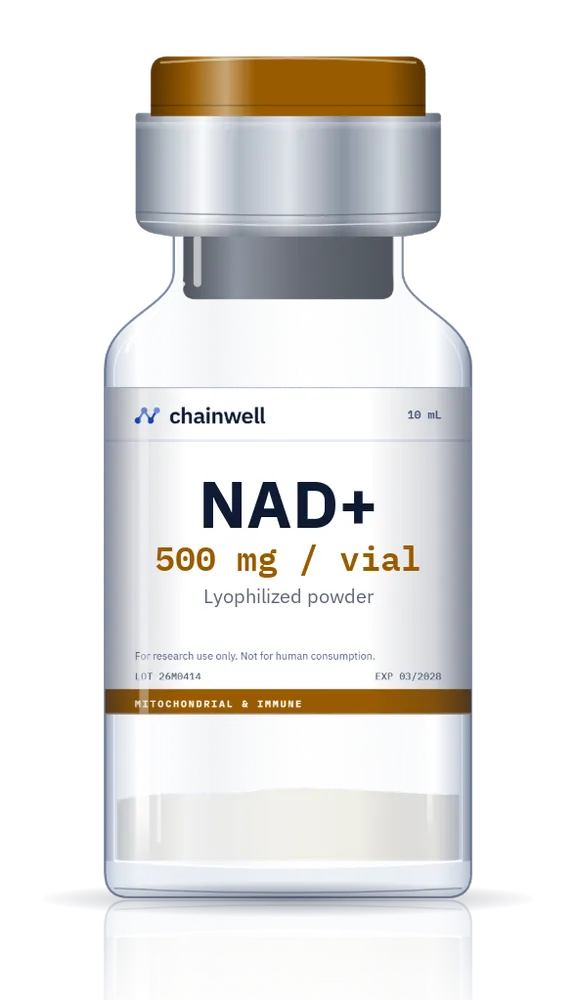
| Chainwell product | 10mg, 40mg | 10mg vial | 500mg vial | 10, 20, 30mg vials |
The MOTS-c and SS-31 stack is a common pairing in mitochondrial research, since one works on signalling and the other on the mitochondrial membrane itself. MOTS-c and NAD+, and retatrutide and MOTS-c, come up in metabolic research. For studies using more than one compound, order separate vials so each can be measured on its own.
MOTS-c Tablets and Oral Forms
We supply MOTS-c as a lyophilized vial only. Searches for MOTS-c tablets are common, but an oral form of MOTS-c is not established: as a 16 amino acid peptide it is exposed to digestive enzymes, and the published research uses the peptide in solution. A vial gives you the compound itself, verified by lot, to prepare at the concentration your study design calls for.
Lab-Tested MOTS-c With a COA for Every Lot
Every Chainwell Peptide MOTS-c lot, 10mg and 40mg alike, is sent to an independent laboratory before release. Mass spectrometry confirms the molecular mass matches MOTS-c, about 2,175 g/mol, and HPLC measures purity. A lot that does not meet specification is not sold. Check your lot on our COA lookup page, and see our guide on how to read a certificate of analysis.
Buy MOTS-c in Australia
Chainwell Peptide supplies MOTS-c peptide in Australia to laboratories, universities and independent researchers, packed and dispatched from within Australia. Before you buy MOTS-c from any supplier, check that the listing states the fill, that the vial carries a lot number, and that the certificate for that lot is available before you pay.
- Same-day dispatch on orders paid before 3pm on a business day.
- Australia-wide delivery to Sydney, Melbourne, Brisbane, Adelaide, Perth, Hobart, Darwin and regional addresses, by standard or express post.
- PayID or bank transfer, with your order number as the payment reference.
- Tracked orders you can follow on our order tracking page.
The MOTS-c price for each size is shown at the top of this page, with GST included; the 40mg vial costs less per milligram. See our shipping policy for delivery details.
MOTS-c Specifications
| Compound | MOTS-c (mitochondrial open reading frame of the 12S rRNA type-c) |
|---|---|
| Class | Mitochondrial-derived peptide |
| Sequence | Met-Arg-Trp-Gln-Glu-Met-Gly-Tyr-Ile-Phe-Tyr-Pro-Arg-Lys-Leu-Arg (MRWQEMGYIFYPRKLR) |
| Length | 16 amino acids |
| Molecular weight | Approximately 2,174.6 g/mol |
| Vial sizes | 10mg, 40mg |
| Form | Lyophilized (freeze-dried) powder |
| Container | 3 mL clear glass vial, rubber stopper, amber flip-off cap |
| Identity and purity | Mass spectrometry and HPLC, per lot |
| Diluent | Bacteriostatic water, sold separately |
| Storage | Minus 20 °C long term, 2 to 8 °C once reconstituted, protect from light |
| Shipping | Standard or express post, Australia-wide |
Research Use Only
MOTS-c is not approved by the Therapeutic Goods Administration for any therapeutic use. Chainwell Peptide sells it strictly for laboratory and in vitro research. It is not for human or veterinary use, and we do not provide dosing advice. By ordering you agree to our terms and conditions and research use only statement.
MOTS-C tools and guides
- MOTS-C Dosage Calculator: bac water, concentration and U-100 syringe units
- MOTS-c Benefits: What the Research Shows So Far
- What Is SLU-PP-332? The Exercise Mimetic Explained
- SLU-PP-332 Capsules vs Vial: What the Oral Evidence Shows
MOTS-C FAQ
What is MOTS-c?
+
MOTS-c is a 16 amino acid peptide encoded in mitochondrial DNA rather than the cell nucleus, first described in 2015. It is studied for its role in metabolic regulation, insulin sensitivity and exercise capacity in cell and animal models. Chainwell Peptide supplies it in 10mg and 40mg vials.
What does MOTS-c do?
+
In research, MOTS-c acts mainly in skeletal muscle, where it activates the energy sensor AMPK. Studies in mice report protection against diet-induced insulin resistance and improved physical performance in aged animals. Under stress it also moves into the nucleus to influence gene expression.
Is MOT-C the same as MOTS-c?
+
Yes. MOT-C, MOT C and MOTS C are common spellings of MOTS-c, which stands for mitochondrial open reading frame of the 12S rRNA type-c. Chainwell Peptide lists it as MOTS-C, and the certificate of analysis confirms the peptide by mass.
Should I buy MOTS-c 10mg or 40mg?
+
Buy the 10mg vial for a first order, method development or a short study, since it is easiest to use within 28 days of reconstitution. Buy the 40mg vial for ongoing work: it costs less per milligram and keeps repeated work on a single lot and certificate.
How do you reconstitute MOTS-c?
+
Add bacteriostatic water slowly down the inside wall of the vial and swirl gently until clear, without shaking. 2 mL gives 5mg per mL in the 10mg vial and 20mg per mL in the 40mg vial. Store it at 2 to 8 °C, protected from light, and use it within 28 days.
Where can I buy MOTS-c in Australia?
+
You can buy MOTS-c in Australia from Chainwell Peptide in 10mg and 40mg lyophilized vials. Every lot carries a lot number matched to an independent certificate of analysis, and orders paid before 3pm on a business day ship the same day by standard or express post.