How the published studies gave SLU-PP-332: injection, not oral
SLU-PP-332 is a small synthetic agonist of the estrogen-related receptors ERR alpha, beta and gamma, developed in Thomas Burris's laboratory. If you are new to the compound, our explainer on what SLU-PP-332 is covers the receptor biology. This post is about one question: does the format matter? It does, because of how the evidence was produced.
The two founding in vivo papers both used intraperitoneal (i.p.) injection, where the compound is injected into the abdominal cavity of the mouse:
- Billon et al., ACS Chemical Biology, 2023. The authors first measured plasma and muscle exposure after an intraperitoneal dose, then ran the muscle fibre, gene expression and treadmill endurance experiments with twice-daily intraperitoneal injections.
- Billon et al., Journal of Pharmacology and Experimental Therapeutics, 2024 (online 2023). In the metabolic syndrome study, diet-induced obese and ob/ob mice received SLU-PP-332 by intraperitoneal injection twice daily for 28 days (12 days for ob/ob mice).
So the headline findings people quote (more oxidative muscle fibres, longer running time, less fat gain, better insulin sensitivity) all come from injected compound. None of them was produced by capsules, drops or tablets.
Does oral SLU-PP-332 work? What its developers say
The clearest statement comes from the Burris group itself. In Billon, Appourchaux, Côté and Burris, "An orally active estrogen receptor-related receptor agonist, SLU-PP-915, enhances aerobic exercise capacity" (Journal of Pharmacology and Experimental Therapeutics, January 2026, published online December 2025), the authors write that they previously developed SLU-PP-332, "which improves aerobic performance in mice but lacks oral bioavailability."
That paper exists because of the oral problem. It introduces SLU-PP-915, a chemically distinct ERR pan-agonist that is orally bioavailable. The authors showed that SLU-PP-915 matched SLU-PP-332 for treadmill distance and duration when both were injected intraperitoneally, and that SLU-PP-915 kept comparable efficacy when given orally, adjusted for systemic exposure. No equivalent oral result is reported for SLU-PP-332.
So does oral SLU-PP-332 work? The honest answer is that there is no published evidence that it does, and the lab that invented it says it lacks oral bioavailability. A 2026 structure-activity study from the same collaborators (Okda et al., International Journal of Biological Macromolecules) described analogues of the SLU-PP-332 scaffold with improved solubility or metabolic stability, which tells you those were properties worth improving.
Why a small molecule can still fail by mouth
Unlike retatrutide or MOTS-c, SLU-PP-332 is not a peptide, so digestive enzymes are not the issue. It is an acyl hydrazone with a molecular weight of about 290. Small molecules usually absorb well, so why would this one not? The published papers do not give a mechanism, but the chemistry points to likely candidates:
- Poor water solubility. SLU-PP-332 is built from two aromatic ring systems and has a calculated XLogP of 3.7. Compounds like this often dissolve poorly in gut fluid, and what does not dissolve is not absorbed.
- First-pass metabolism. Anything absorbed from the gut passes through the liver before reaching the rest of the body. Two 2026 in vitro studies using human liver fractions (Avliyakulov et al., Drug Testing and Analysis; Möller et al., Rapid Communications in Mass Spectrometry) identified hydroxylated metabolites plus glucuronide and sulfate conjugates of SLU-PP-332. Its free phenol group is a classic target for this kind of conjugation.
- Acid sensitivity. Hydrazone bonds are generally prone to hydrolysis in acidic conditions, and the stomach is acidic. Whether this affects SLU-PP-332 in practice has not been published, so treat it as a question, not a finding.
Those doping-control papers exist because the World Anti-Doping Agency prohibits exercise mimetics and metabolic modulators in sport, and SLU-PP-332 has drawn attention as a potential misuse target.
SLU-PP-332 drops, tablets, liquid and capsules: what the evidence covers
Search data shows steady interest in SLU-PP-332 drops, tablets, liquid and capsule forms. Here is how each format lines up against the published evidence:
| Format | Published pharmacokinetic data | Matches published efficacy studies? |
|---|---|---|
| Lyophilised powder in a vial | Plasma and muscle exposure measured after injection (ACS Chem Biol, 2023) | Yes: the studies dissolved and injected the compound in mice |
| Capsules | None published | No |
| Tablets | None published | No |
| Oral drops or liquid | None published | No |
Drops and liquids add a second problem: a poorly water-soluble molecule needs a solvent or carrier to stay in solution, and sellers rarely say what that is or how stable the compound is in it over weeks at room temperature. A lyophilised powder avoids that question until the researcher chooses the vehicle.
None of this proves oral formats are inactive. It means nobody has published the data to show they are active, and the compound's developers have stated the opposite. The same applies to "slu pp 332 injection vs oral" comparisons online: without published oral exposure data, there is nothing to compare.
Chainwell Peptide's SLU-PP-332 capsules: a plain statement
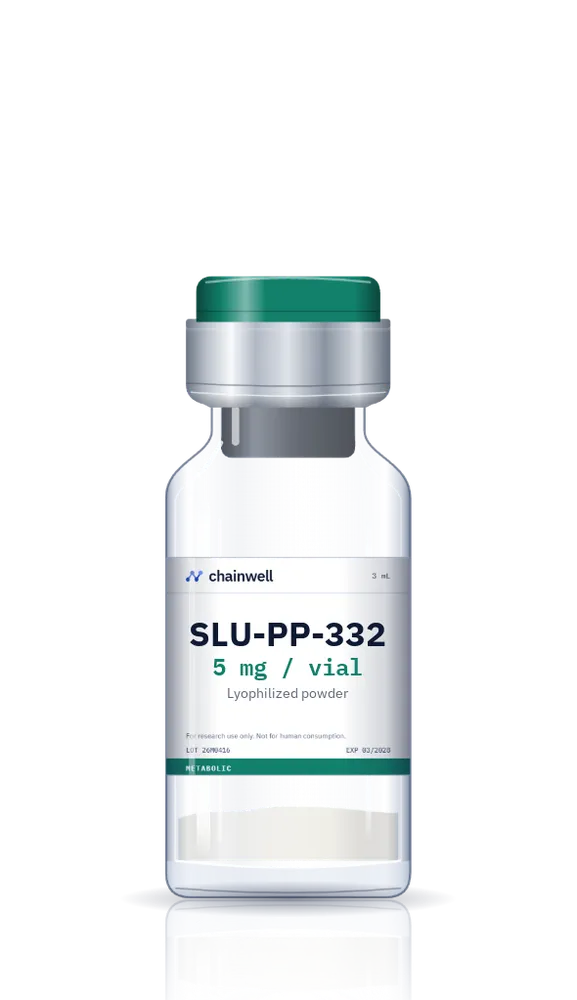
Chainwell Peptide sells SLU-PP-332 in two formats: a 5 mg lyophilised vial and a pack of 60 capsules. Both are sold for laboratory research only, and every lot of each is tested by an independent laboratory for identity by mass spectrometry and purity by HPLC, with the lot number matching its certificate on our certificate of analysis lookup.
We are not going to tell you the capsules work orally, because the published evidence does not support that claim. The capsule format exists for researchers who want to study oral exposure directly, for example measuring how much compound reaches plasma by that route or comparing formulations. That is a legitimate research question, and one the literature has not answered. It is not a format to choose if the aim is to reproduce the published endurance or metabolic results.
Our recommendation: if your work is meant to build on Billon et al., use the SLU-PP-332 5 mg vial. If you are asking whether oral SLU-PP-332 reaches the circulation at all, the capsules plus a way to measure exposure make sense. For how to handle freeze-dried material and what the numbers on a COA mean, see the guide to reading a certificate of analysis and our storage guide for lyophilised compounds.
Related research compounds for mitochondrial and metabolic work
Researchers studying SLU-PP-332 usually work across several nodes of mitochondrial and metabolic signalling. The compounds most often used alongside it are:
- MOTS-c, a 16 amino acid mitochondrial-derived peptide that acts through AMPK rather than the ERRs. Our summary of MOTS-c research findings covers the animal and human data.
- 5-Amino-1MQ, a small molecule NNMT inhibitor studied for fat cell metabolism.
- NAD+ in a 500 mg vial, the redox cofactor at the centre of mitochondrial energy metabolism.
- SS-31 (elamipretide), a tetrapeptide that targets cardiolipin in the inner mitochondrial membrane.
All of these, like SLU-PP-332, are sold by Chainwell Peptide for laboratory research only, not for human or veterinary use, and nothing here is dosing or administration advice. Orders paid before 3pm AEST on a business day are dispatched the same day by tracked post from within Australia. Browse the mitochondrial research compounds for the full range.
Frequently asked questions
Can SLU-PP-332 be taken orally?
+
There is no published evidence that SLU-PP-332 is active by mouth. Its developers, in a 2026 JPET paper, describe it as lacking oral bioavailability, and the published mouse studies from the same lab gave it by intraperitoneal injection. The same lab developed a different compound, SLU-PP-915, specifically because it is orally bioavailable.
Do SLU-PP-332 capsules work?
+
No published study has tested SLU-PP-332 capsules or any oral SLU-PP-332 product. The endurance and metabolic results come from injected compound in mice. Capsules are useful for research that measures oral exposure directly, but there is no evidence they reproduce the published findings.
What is the difference between SLU-PP-332 and SLU-PP-915?
+
Both are ERR pan-agonists from the Burris laboratory, but they are chemically distinct. SLU-PP-332 came first and lacks oral bioavailability. SLU-PP-915, described in JPET in 2026, is orally bioavailable and matched SLU-PP-332's effect on treadmill endurance in mice when both were injected, with comparable efficacy when given orally.
Are SLU-PP-332 drops or liquid better than capsules?
+
There is no published data on either. Oral drops and liquids face the same absorption question as capsules, plus a stability question, because a poorly water-soluble compound needs a solvent to stay dissolved. A lyophilised vial keeps the compound dry until the researcher chooses the vehicle.
Why choose the SLU-PP-332 vial over capsules?
+
Because the vial matches the published studies. Billon et al. measured exposure and ran their endurance and metabolic experiments using injected compound. A lab that wants results comparable with that literature should start from the same kind of material, while oral formats suit studies designed to measure oral exposure itself.