GHK-Cu Before and After: Where the Real Evidence Comes From
GHK-Cu is glycyl-L-histidyl-L-lysine bound to a copper(II) ion. In cosmetic ingredient lists it appears as copper tripeptide-1. Almost all of the human "before and after" data for it comes from one type of study: a cream or serum applied to the skin twice a day, compared against a placebo base or a competing active, with results measured by a blinded assessor, an imaging system or a skin biopsy.
That is a narrow evidence base, and it matters for how you read any claim. There is a large body of cell culture and animal work on GHK-Cu (collagen synthesis in fibroblasts, wound contraction, gene expression), but the human skin data consists of a few trials of topical products, several of them presented at conferences rather than published as full papers. For the background on the molecule itself, see our guide to what GHK-Cu is and where it came from.
The Controlled GHK-Cu Studies and What They Measured
These are the human skin studies most often cited, with what each one measured. They are summarised in two reviews by Loren Pickart, the chemist who first isolated GHK (BioMed Research International, 2015; International Journal of Molecular Sciences, 2018).
| Study | Subjects and length | What was measured | Reported result |
|---|---|---|---|
| Abdulghani et al., Disease Management and Clinical Outcomes, 1998 | 20 healthy volunteers, 1 month, creams on the thigh | Procollagen in skin biopsies (immunohistology) | Collagen production increased in 70% of the GHK-Cu group, against 50% with vitamin C cream and 40% with retinoic acid |
| Leyden et al., American Academy of Dermatology meeting, 2002 (face cream) | 71 women, 12 weeks | Skin density and thickness, laxity, clarity, fine lines, wrinkle depth | Improvements on each measure against baseline |
| Leyden et al., 2002 (eye cream) | 41 women, 12 weeks | Lines, wrinkles, skin density and thickness | Outperformed placebo and a vitamin K cream |
| Finkley, Appa and Bhandarkar, 2005 | 67 women aged 50 to 59, 12 weeks, twice daily | Laxity, firmness, wrinkles, mottled pigmentation, biopsy histology | Improvements reported, with increased keratinocyte proliferation on biopsy |
| Badenhorst et al., Journal of Aging Science, 2016 | 40 women aged 40 to 65, 8 weeks, randomised and double-blind | Wrinkle volume and depth by imaging | Wrinkle volume 31.6% lower than a Matrixyl 3000 product and 55.8% lower than the base serum; wrinkle depth 32.8% lower than the base serum |
The Badenhorst trial is the strongest of the group: randomised, double-blind, with both a vehicle control and an active comparator, and it delivered GHK-Cu in lipid nano-carriers to help it penetrate the skin. The Abdulghani study is the only one that looked directly at collagen in tissue, and it was a small pilot.
A Result That Did Not Show Up: The Laser Resurfacing Study
Not every trial found a difference. Miller and colleagues (Archives of Facial Plastic Surgery, 2006) applied GHK-Cu skin care products to faces after CO2 laser resurfacing. Blinded evaluators and computer analysis found no significant difference in redness, wrinkles or overall skin quality between the GHK-Cu group and the comparison group. The patients using GHK-Cu, however, rated their own results significantly better.
That gap between objective measurement and self-rated satisfaction is the whole problem with before and after claims in one study. People who believe they are using an active product report more improvement, even when an instrument or a blinded dermatologist cannot see it.
How Long the Studies Ran Before Measuring Results
Searches for how long it takes to see results from GHK-Cu have a straightforward answer in the literature: the controlled studies measured at one month (the biopsy pilot), eight weeks (the nano-carrier trial) and twelve weeks (the Leyden and Finkley creams). None reported next-day or one-week changes, and none followed subjects for longer than about three months.
- Collagen and density were measured at one to three months, because dermal collagen is laid down and remodelled slowly.
- Wrinkle depth and volume were measured at eight to twelve weeks with imaging, not by eye.
- No long-term data exists on whether any changes persist after application stops.
So a photo showing a transformation after a few days is, by the standards of the actual research, showing something other than a copper peptide effect on collagen.
GHK-Cu Peptide Injection Before and After Photos
A large share of searches now ask about GHK-Cu peptide injection before and after results. We could not find a published controlled trial of injected GHK-Cu measuring skin appearance. Every study in the table above was topical. The US Food and Drug Administration, reviewing GHK-Cu as a compounding ingredient, stated that compounded injectable drugs containing GHK-Cu "may pose risk for immunogenicity due to the potential for aggregation and peptide-related impurities" and that "there are limited data in humans to inform safety-related considerations" (FDA bulk drug substances list, updated April 2026).
In Australia, the TGA's April 2026 safety alert on unapproved peptide products named GHK-Cu among products that have not been evaluated for safety, quality or effectiveness. Injection photos online therefore sit outside any controlled evidence at all. Our guide to GHK-Cu side effects and safety data covers what has and has not been studied.
Why Social Media Before and After Photos Are Not Evidence
Skin photographs are one of the easiest things in the world to vary without changing the skin. Before you give any weight to a GHK-Cu before and after post, run through what the controlled studies had to remove:
- Lighting and angle. Overhead light deepens lines; soft front light erases them. Studies used fixed imaging rigs for this reason.
- Hydration and time of day. Skin photographed after a shower, a moisturiser or a good night's sleep looks plumper within minutes.
- Filters and editing. Phone cameras apply smoothing by default, and many posts are edited further.
- Other treatments. Retinoids, sunscreen habits, laser, fillers or weight change during the same period are rarely disclosed.
- Selection. Only the best results get posted; nobody photographs the months where nothing changed.
- Commercial interest. Many posts link to a product for sale.
Our view is simple: if a result has no control group, no blinded assessment and no stated timeframe, treat it as marketing. The trials above are small, but they are the only GHK-Cu before and after data worth quoting.
Working With GHK-Cu in the Lab
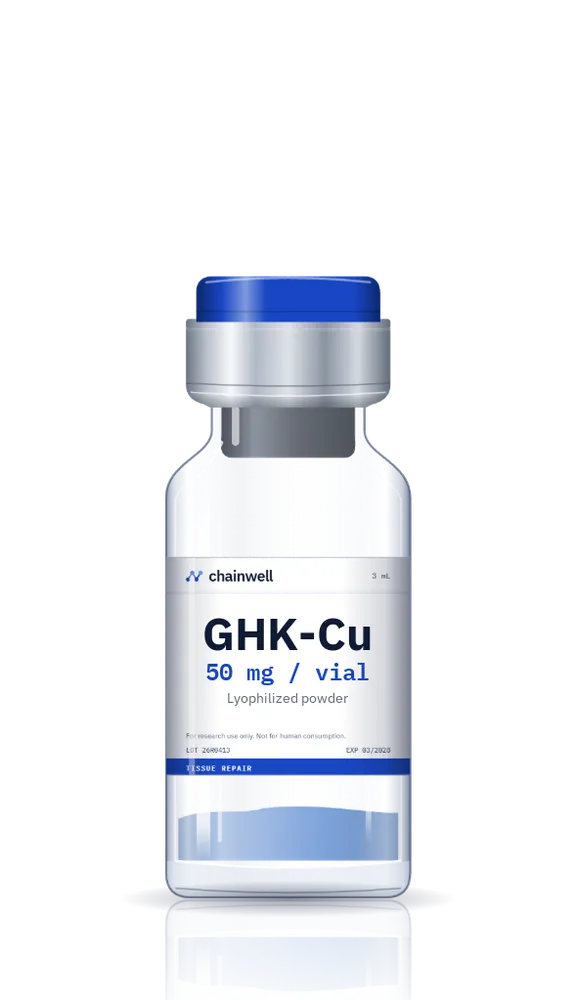
For laboratory work on copper peptides, what you need is the compound itself with verified identity. A genuine GHK-Cu cake is blue, because the colour comes from the bound copper; a white cake labelled GHK-Cu suggests the copper is missing. Check the lot number on the vial against its certificate on our COA lookup page, and use the GHK-Cu reconstitution calculator to work out concentrations for your protocol. Related compounds sit in our skin and cellular peptide range.
Chainwell Peptide sells GHK-Cu for laboratory research use only, as set out in our research use only policy. It is not for human or veterinary use, and nothing on this page is advice on applying or injecting it.
Frequently asked questions
Does GHK-Cu actually work in before and after studies?
+
Controlled topical studies reported modest improvements. A 1998 biopsy pilot found increased collagen production in 70% of GHK-Cu users, and a 2016 double-blind trial found 31.6% lower wrinkle volume than a Matrixyl 3000 product after 8 weeks. A 2006 study after laser resurfacing found no objective difference. The studies were small and all used creams or serums, not injections.
How long did GHK-Cu studies run before measuring results?
+
Between one month and twelve weeks. The Abdulghani biopsy pilot measured at one month, the Badenhorst nano-carrier trial at eight weeks, and the Leyden and Finkley cream studies at twelve weeks. None of the published human skin studies measured results after only days, and none tracked whether changes lasted after application stopped.
Are there GHK-Cu peptide injection before and after studies?
+
We could not find a published controlled trial of injected GHK-Cu measuring skin appearance. The human skin data is from topical products. The US FDA has said there are limited human data to inform the safety of compounded injectable GHK-Cu, and the TGA lists GHK-Cu among unapproved peptide products not evaluated for safety or effectiveness.
Why do GHK-Cu before and after photos look so dramatic?
+
Because lighting, camera angle, hydration, filters and editing can change how skin looks far more than any cream can in weeks. Posts also select the best cases, rarely disclose other treatments such as retinoids or laser, and often promote a product. Controlled studies removed these factors with fixed imaging and blinded assessors, and found much smaller changes.