What Is GHK-Cu Peptide?
GHK is a tripeptide: glycine, histidine and lysine, in that order. On its own it is colourless. It has a strong affinity for copper(II) ions and binds them spontaneously to form the complex written GHK-Cu, which is the form sold for research and the form used in cosmetics under the name copper tripeptide-1. The copper is held by the histidine and the peptide backbone, tightly enough to carry it through tissue fluid but loosely enough to pass it on to cells.
The copper is also why the compound looks the way it does. Most lyophilized peptides are a white powder; GHK-Cu is blue, and so is the solution made from it. For a research lab, that colour is the first identity check on any vial.
Discovered in Human Plasma in 1973
GHK was first described by Loren Pickart and Martin Thaler in Nature New Biology in 1973. Pickart had found that a fraction of human plasma albumin made liver tissue from older donors synthesise proteins in the pattern of younger tissue. The active factor was tentatively identified as the tripeptide glycyl-L-histidyl-L-lysine. Its copper binding was characterised in later work.
GHK occurs naturally. Pickart's reviews report plasma levels of about 200 ng/mL at age 20 falling to about 80 ng/mL by age 60, a decline that has driven much of the interest in it as an ageing research target.
What Does GHK-Cu Do? The Main Research Areas
Most searches ask about GHK-Cu peptide benefits. In research terms, these are the lines of work with published data, from strongest human evidence to most preliminary:
- Collagen and skin structure. Maquart and colleagues (FEBS Letters, 1988) reported that GHK-Cu stimulated collagen synthesis in fibroblast cultures at concentrations as low as 10 to the power of minus 12 molar, peaking at about 80% above control. Small human trials of topical creams reported increased skin density and reduced wrinkle depth over 8 to 12 weeks.
- Wound models. Animal studies have examined GHK-Cu in wound contraction, new blood vessel formation and the remodelling of scar tissue.
- Gene expression. Using the Broad Institute's Connectivity Map, Pickart's group reported that GHK changed the expression of 31.2% of human genes by 50% or more, increasing 59% of those and suppressing 41%, including genes in tissue repair and antioxidant pathways (International Journal of Molecular Sciences, 2018).
- Copper delivery. GHK's ability to carry and release copper is thought to underlie part of its activity, since copper is a cofactor for enzymes such as lysyl oxidase, which cross-links collagen and elastin.
The honest summary of GHK-Cu benefits is that the cell and gene data are broad, while the human evidence is limited to topical skincare trials with small numbers. Our article on GHK-Cu before and after studies sets out each trial and what it measured. Browse the source papers in our GHK-Cu research library.
GHK-Cu Benefits: What the Evidence Does Not Show
Three caveats apply to almost every claim you will read about GHK-Cu. First, much of the literature is summarised in reviews written by Pickart himself, the peptide's discoverer, so independent replication is thinner than the volume of citations suggests. Second, the human trials used creams, often at low concentrations, not injections. Third, gene expression data shows which genes move in cultured cells, which is not the same as showing a clinical effect.
None of that makes GHK-Cu uninteresting. It makes it a compound with a real research record that is still mostly preclinical outside of cosmetics.
Is GHK-Cu Legal in Australia?
We are not lawyers, and this is not legal advice, but these points can be verified. GHK-Cu is not an approved medicine in Australia: there is no GHK-Cu product on the Australian Register of Therapeutic Goods (ARTG) for therapeutic use. In April 2026 the TGA issued a safety alert naming GHK-Cu, alongside BPC-157, TB-500, retatrutide and CJC-1295, as examples of unapproved peptide products that have not been evaluated for safety, quality or effectiveness, and it has made unapproved peptide products a compliance priority.
Skincare containing copper tripeptide-1 is sold in Australia as cosmetics, which is a separate category from therapeutic goods. For anything beyond that, check the TGA's current guidance and the current Poisons Standard (SUSMP) rather than relying on supplier websites. Chainwell Peptide supplies GHK-Cu only as a research chemical for laboratory use.
GHK-Cu Vials, Kits and Blends
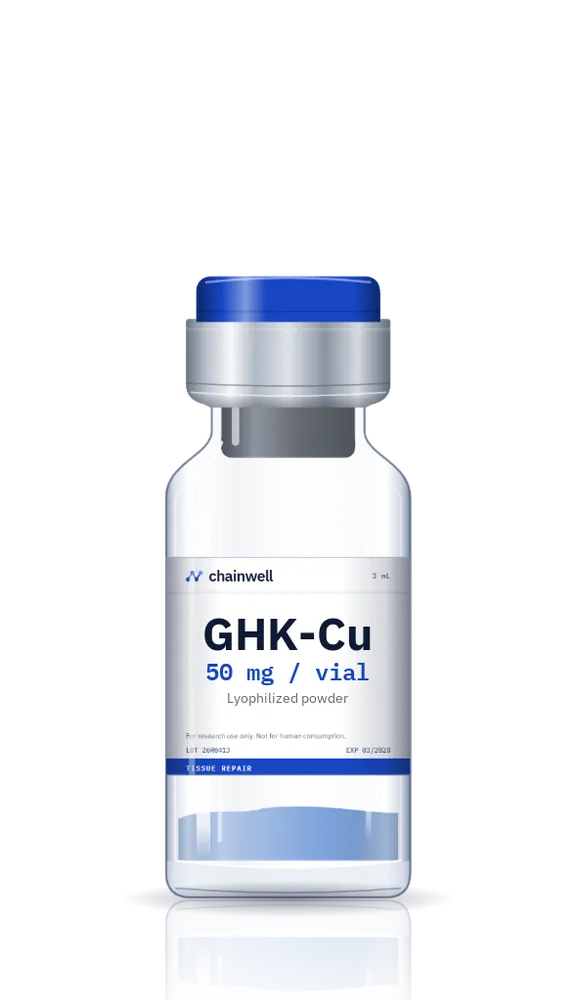
Chainwell Peptide stocks GHK-Cu in two fills. The 50 mg vial suits new work and method development; the 100 mg vial suits labs running repeated assays from one lot and one certificate. Both are sealed in a 3 mL glass vial and are best stored frozen at minus 20 °C before reconstitution. Our GHK-Cu peptide calculator works out concentrations for either fill.
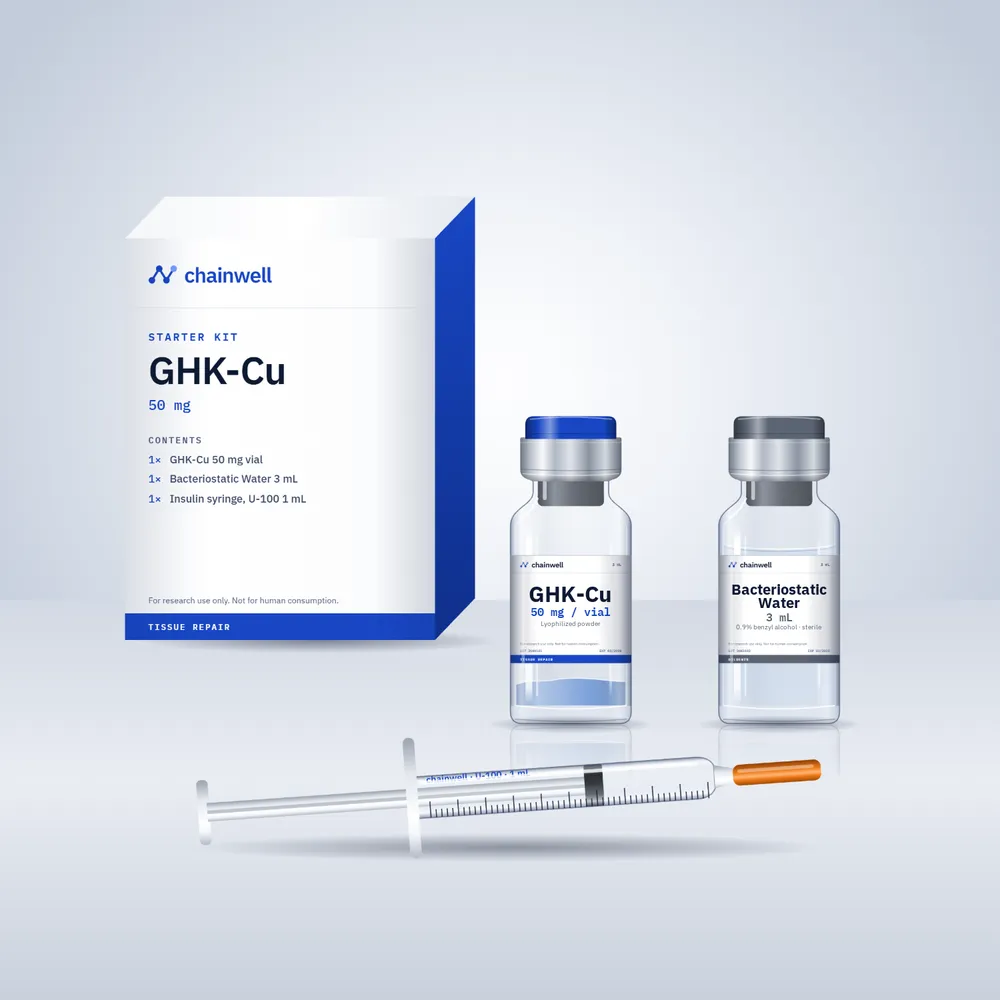
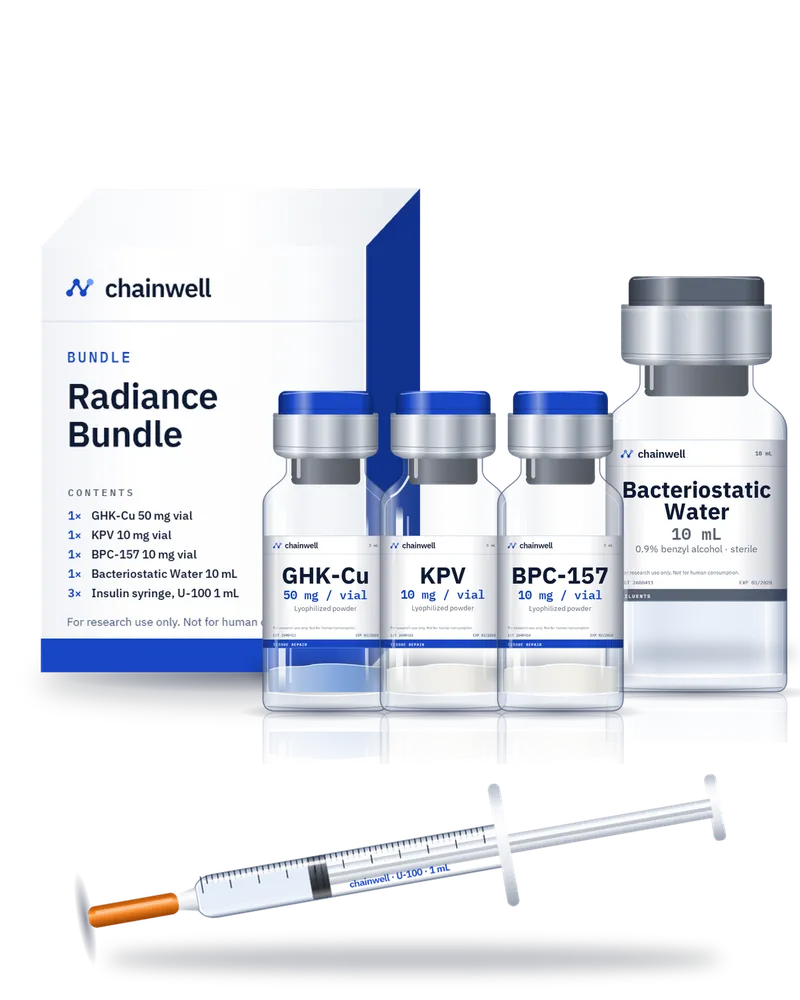
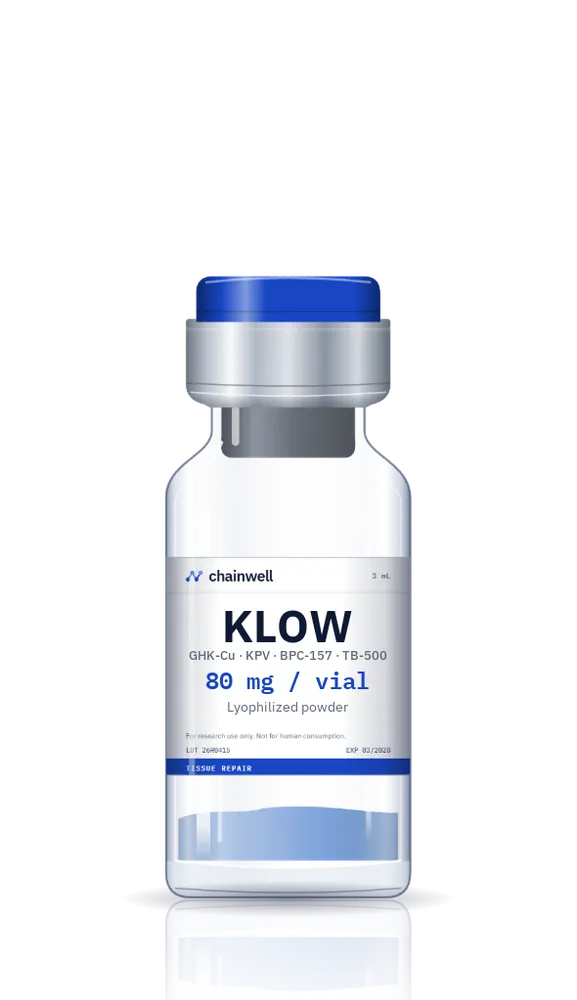
If you need the diluent and a syringe as well, the GHK-Cu Starter Kit combines a 50 mg vial with 3 mL of bacteriostatic water and a U-100 syringe. For multi-compound skin research, the Radiance Bundle packs GHK-Cu 50 mg with KPV 10 mg and BPC-157 10 mg as separate vials, and our comparison of the GLOW and KLOW blends explains the pre-mixed options. Our recommendation for most labs: start with the single GHK-Cu vial, since a solution with one compound in it is the only way to attribute an effect to GHK-Cu.
How to Check a GHK-Cu Vial
Look at the cake first: it should be blue. Then match the lot number on the label to its certificate of analysis, which should confirm identity by mass spectrometry and purity by HPLC. Every Chainwell Peptide lot is tested this way by an independent laboratory, and the certificates are on our lot-matched COA lookup. Our guide on reading a certificate of analysis explains each line of the report.
GHK-Cu from Chainwell Peptide is sold for laboratory research use only, not for human or veterinary use.
Frequently asked questions
What is GHK-Cu made of?
+
GHK-Cu is the tripeptide glycyl-L-histidyl-L-lysine (glycine, histidine, lysine) bound to a copper(II) ion. The peptide itself is colourless; the bound copper makes the powder and its solution blue. In cosmetic ingredient lists the same complex is called copper tripeptide-1.
What does GHK-Cu do?
+
In research, GHK-Cu stimulates collagen synthesis in fibroblast cultures, has been studied in animal wound healing models, and changes the expression of a large number of human genes in cell data. Small human trials of topical creams reported increased skin density and reduced wrinkle depth over 8 to 12 weeks. Injected use has limited human data.
What are the main GHK-Cu peptide benefits in studies?
+
The best documented are increased collagen production in cell culture and in one small biopsy study, and improvements in wrinkle depth, skin density and thickness in topical cream trials of 40 to 71 women. Wound healing findings come mainly from animal models, and gene expression findings from cell-based data.
Is GHK-Cu legal in Australia?
+
GHK-Cu is not an approved medicine in Australia and has no ARTG entry for therapeutic use. The TGA's April 2026 safety alert named GHK-Cu among unapproved peptide products not evaluated for safety, quality or effectiveness. Copper tripeptide-1 skincare is sold as cosmetics. Check current TGA guidance for your situation; this is not legal advice.
Why is GHK-Cu blue?
+
The blue colour comes from the copper(II) ion bound to the peptide. Plain GHK without copper is colourless, so a white cake in a vial labelled GHK-Cu suggests the copper complex is missing. A genuine vial shows a blue powder and gives a clear blue solution when reconstituted.