GHK-Cu Side Effects: The Short Answer
Split the question by route, because the evidence is completely different for each:
| Route | What exists | What it shows |
|---|---|---|
| Topical cosmetics | A formal cosmetic safety assessment and several small clinical trials | Considered safe as used in cosmetics at the low concentrations reported |
| Injected | No controlled human safety trials that we could find; regulator statements; online anecdotes | Unknown. Regulators cite limited human data and immunogenicity concerns |
| Laboratory (in vitro) | Decades of cell culture work | Not a safety question for people; a question of reagent quality |
So when someone asks about GHK-Cu peptide side effects, the only accurate answer is "which kind of use, and which product?"
Topical GHK-Cu: The Cosmetic Safety Record
The US Cosmetic Ingredient Review Expert Panel assessed tripeptide-1 and its metal salts, which include copper tripeptide-1, and concluded in 2018 (International Journal of Toxicology) that they are safe in cosmetics in the present practices of use and concentration. The panel noted that use concentrations were low and that the safety test data it reviewed were negative.
The human cream trials support that picture. The studies reviewed by Pickart, including 71 and 41 women over 12 weeks (Leyden, 2002) and 67 women over 12 weeks (Finkley, 2005), are described in his 2015 review, which states that no issues have arisen from GHK-Cu's use as a skin cosmetic or in human wound healing studies. Keep in mind that those reviews come from the peptide's discoverer, and that a clean cosmetic record at low concentration says nothing about injecting milligram quantities.
As with any skin product, individual irritation or allergy is possible. A dermatologist, not a peptide supplier, is the right person to assess that.
GHK-Cu Injection Side Effects: What Is and Is Not Known
Searches for GHK-Cu injection side effects mostly lead to forum posts describing redness, stinging, lumps or itching at an injection site, flushing, or fatigue. Those are anecdotes. They cannot tell you how often a reaction occurs, whether the peptide or a contaminant caused it, or what dose was involved.
What regulators have said is more useful:
- US FDA. In its list of bulk drug substances reviewed for compounding (updated April 2026), the FDA stated that "compounded injectable drugs containing GHK-Cu may pose risk for immunogenicity due to the potential for aggregation and peptide-related impurities" and that "there are limited data in humans to inform safety-related considerations."
- TGA. The TGA's April 2026 safety alert named GHK-Cu among unapproved peptide products that have not been evaluated for safety, quality or effectiveness. Across unapproved peptides generally, it reported adverse events including severe allergic reactions requiring hospitalisation, severe inflammation and full-body itching. Those reports were not attributed to GHK-Cu specifically.
Immunogenicity means the immune system reacting to the product, which is more likely when a peptide clumps together or carries impurities from synthesis. That is a quality problem as much as a pharmacology one, which leads to the next section.
Copper Considerations
Each GHK-Cu molecule carries one copper ion, so the compound is also a copper source. Copper is an essential trace element, but excess copper is toxic, with the liver the main organ affected, and some people have a genetic condition (Wilson disease) in which copper accumulates. The amounts in cosmetic creams are tiny. The amounts in research vials are not: tens of milligrams of peptide per vial. No controlled study has examined copper balance after repeated injection of GHK-Cu, which is another reason injected use sits outside the evidence.
A second copper issue is chemical. A poorly made product can contain copper that is not bound to the peptide, or peptide with too little copper. A certificate of analysis that confirms the GHK-Cu mass by mass spectrometry is how a lab knows the complex is what the label says.
Quality Problems That Look Like Side Effects
A large share of reported problems with grey-market peptides trace back to the product, not the molecule. For GHK-Cu, these are the checks that matter:
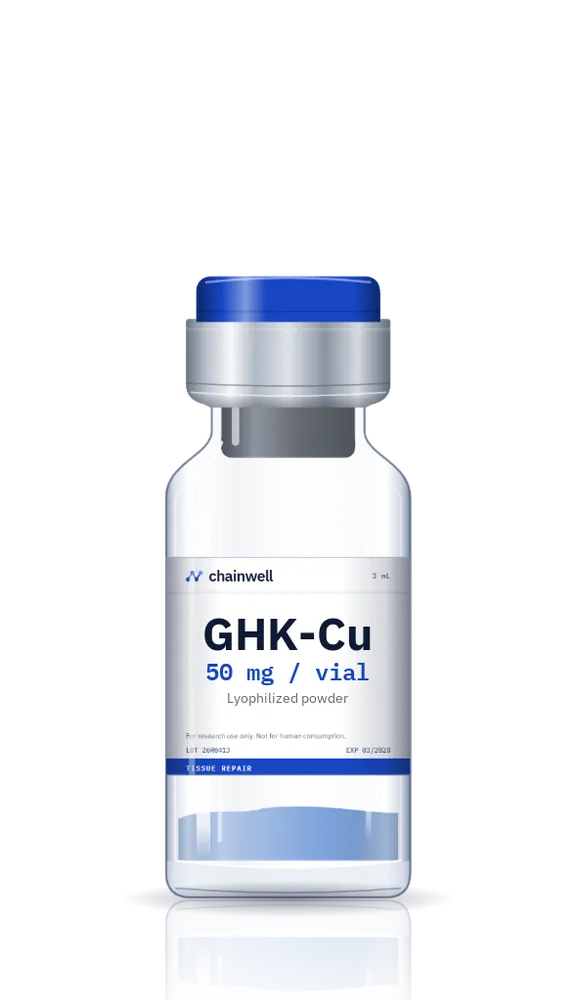
- Wrong colour. Genuine GHK-Cu is blue. A white or colourless cake suggests plain GHK with no copper, or something else entirely.
- Missing or wrong compound. Only mass spectrometry confirms identity. A label is not evidence.
- Low purity. Synthesis by-products and truncated peptides show up on HPLC as extra peaks. These are the impurities the FDA links to immunogenicity.
- Contamination. A standard identity and purity certificate does not test sterility or endotoxin. Treat any non-sterile research chemical accordingly.
- Degradation. A reconstituted solution that turns cloudy or loses its blue colour should be discarded. Our storage guide for lyophilized peptides covers temperatures and light.
Our opinion: the COA is the minimum, and it only means something when the lot number on the certificate matches the vial in your hand. Every Chainwell Peptide lot is tested by an independent laboratory, and you can check it on the COA lookup page before ordering. Our explainer on how to read a COA shows what a pass looks like, and our quality testing process describes the method.
Handling GHK-Cu in the Lab
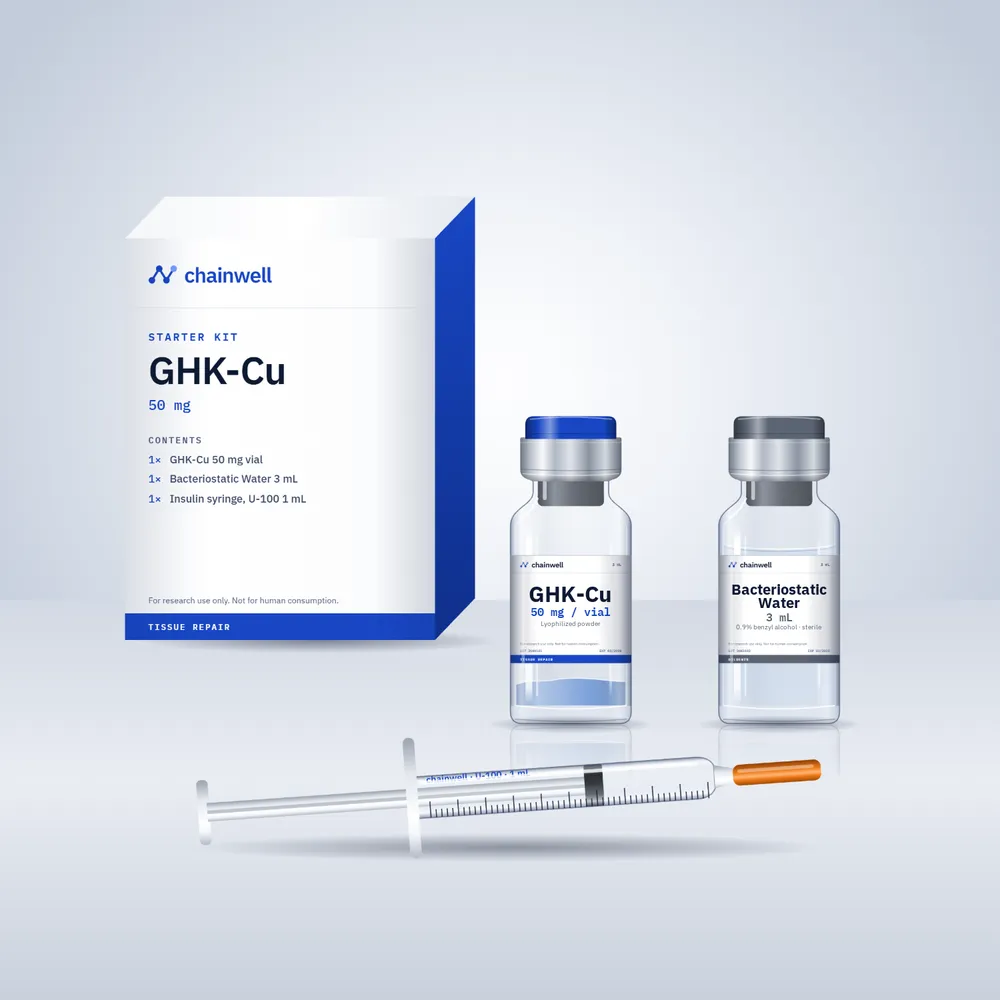
For laboratory preparation, reconstitute with bacteriostatic water, refrigerate the solution at 2 to 8 °C away from light, and use it within 28 days. The GHK-Cu calculator works out the concentration for a 50 mg or 100 mg fill. For background on the compound and its research record, read our overview of the GHK-Cu copper peptide.
GHK-Cu from Chainwell Peptide is for laboratory research use only. It is not for human or veterinary use, and this page is not medical advice.
Frequently asked questions
What are the side effects of GHK-Cu?
+
For topical cosmetics, GHK-Cu has a clean record: a 2018 Cosmetic Ingredient Review assessment found copper tripeptide-1 safe as used, and small cream trials reported it well tolerated. For injected GHK-Cu there are no controlled human safety studies; reports of injection-site redness, itching or lumps are anecdotal. The FDA cites limited human data and immunogenicity risk.
Is GHK-Cu safe?
+
As a low-concentration cosmetic ingredient, it has been assessed as safe as used. Injected GHK-Cu has not been evaluated in controlled human safety trials, and the TGA lists GHK-Cu among unapproved peptide products not assessed for safety, quality or effectiveness. Whether any particular product is safe also depends on its purity and contamination.
Why does the FDA mention immunogenicity for GHK-Cu?
+
The FDA stated that compounded injectable GHK-Cu may pose a risk of immunogenicity because of possible aggregation and peptide-related impurities. In plain terms, clumped peptide or synthesis by-products can provoke an immune reaction. It also noted that there are limited human data to inform safety considerations for that use.
How can you tell if a GHK-Cu vial is bad?
+
Check the colour first: genuine GHK-Cu is blue, so a white cake suggests missing copper. Then match the lot number to a certificate showing identity by mass spectrometry and purity by HPLC. A reconstituted solution that turns cloudy or loses its blue colour has degraded and should be discarded.