Does Chainwell Peptide Sell a GHK-Cu Serum?
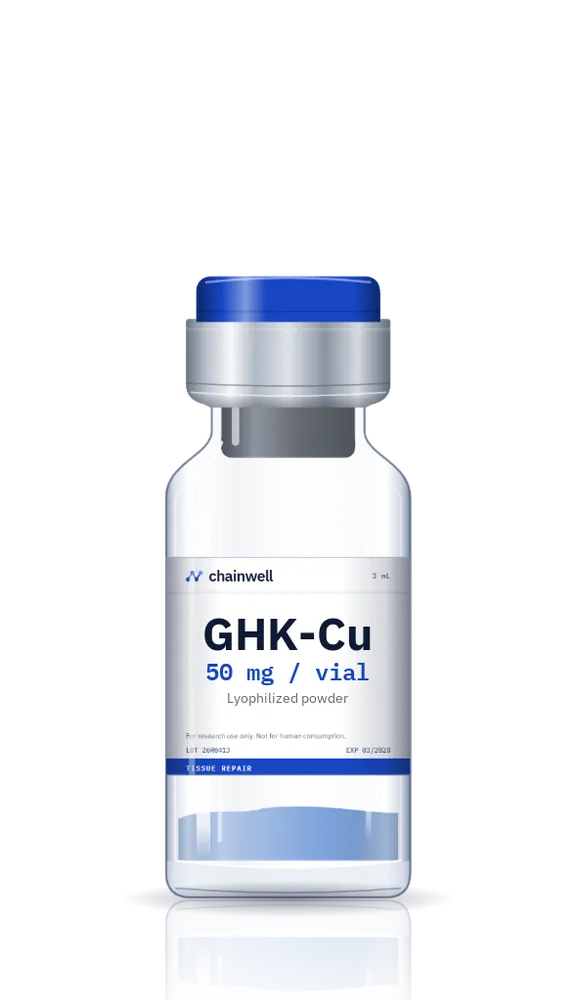
No. We want to be direct about this because a lot of people land on a peptide supplier's site searching for a GHK-Cu serum, a GHK-Cu cream or a topical GHK-Cu product for their face or hair. Chainwell Peptide does not make, sell or recommend any serum, cream, lotion or hair product. What we sell is the raw compound: freeze-dried GHK-Cu in sealed glass vials, supplied for laboratory research.
Those two things share a molecule and nothing else. A serum is a finished cosmetic, formulated with water, humectants, preservatives and thickeners so it can sit in a bathroom cabinet for months. A research vial is a single dry reagent with a certificate, meant to be weighed into an experiment. The rest of this page explains what the cosmetic versions contain, so you can read their labels properly, and then what the research format is for. If you want the background on the peptide itself first, read our explainer on what GHK-Cu is.
What a GHK-Cu Serum or Copper Peptide Cream Contains
GHK-Cu is glycyl-L-histidyl-L-lysine bound to a copper(II) ion. On a cosmetic ingredient list it does not appear as "GHK-Cu". Cosmetic labels use INCI names (International Nomenclature of Cosmetic Ingredients), and the INCI name for the copper complex is copper tripeptide-1. The US Cosmetic Ingredient Review (CIR) Expert Panel reviewed it alongside related GHK ingredients and concluded they are safe in the present practices of use and concentration in cosmetics (International Journal of Toxicology, 2018).
That same CIR report shows why label names matter. Several GHK ingredients exist, and they are not interchangeable:
- Copper tripeptide-1: GHK with copper bound. This is the copper peptide.
- Tripeptide-1: plain GHK with no copper.
- Palmitoyl tripeptide-1: GHK with a palmitic acid chain attached to help it enter skin, and no copper. It is one of the two peptides in the Matrixyl 3000 ingredient.
- Bis(tripeptide-1) copper acetate: another copper salt of GHK, which the CIR listed as not reported in current use at the time.
So a "peptide serum" can contain GHK without any copper at all. If the product is sold as a copper peptide serum, copper tripeptide-1 (or another copper salt) should be on the INCI list.
In Australia, cosmetics are not regulated by the TGA the way medicines are. Ingredients are introduced under the Australian Industrial Chemicals Introduction Scheme (AICIS), and the ACCC enforces the Consumer Goods (Cosmetics) Information Standard 2020, which requires ingredients to be listed by INCI name in descending order of concentration, with ingredients at 1% or less allowed in any order after the rest. The TGA becomes relevant when a product makes therapeutic claims: its guidance treats "contains collagen to smooth the appearance of fine lines" as a cosmetic claim, but "stimulates collagen production to repair skin at the cellular level" as a therapeutic one.
How Much GHK-Cu Is in Topical Products and Studies
Cosmetic use levels are very low. The CIR report recorded that the GHK-type peptides it reviewed are typically used at under 10 parts per million (ppm), with one industry submission describing peptide use between 1 and 30 ppm. Across the whole group of ingredients, the highest concentration in the Personal Care Products Council survey was 0.002%, reported for a different peptide in leave-on products. For reference, 10 ppm is 0.001%, or 10 micrograms of ingredient per gram of product.
Low numbers are not automatically a problem, because cell studies report effects at extremely low concentrations. A 2023 study of liposomal GHK-Cu in Pharmaceutics noted that increased collagen and elastin production has been reported at GHK-Cu concentrations of 0.01 to 100 nanomolar. The real limitation is getting the peptide into skin at all: GHK-Cu is hydrophilic, and the same paper points out that hydrophilic peptides have difficulty crossing the stratum corneum. That is why the most cited controlled trial, Badenhorst and colleagues (Journal of Aging Science, 2016), delivered GHK-Cu in nano-lipid carriers, and why formulation research keeps returning to liposomes. The Pharmaceutics team built their liposomes at 0.5 mg of peptide per cubic centimetre and buffered them at pH 6.
What this means for a buyer of a topical GHK-Cu serum: the percentage on the front of a bottle tells you less than the delivery system and the pH. For what the human cream trials actually measured, and over how many weeks, see the GHK-Cu before and after study summary.
GHK-Cu Serum With Vitamin C, Acids and Retinoids
This is the question most copper peptide serum users ask, and it is mostly chemistry, so here is what the published chemistry supports.
pH and strong acids
The copper in GHK-Cu is held by the glycine amino group, a peptide backbone nitrogen and the histidine ring. Binding is pH dependent: Bossak-Ahmad and colleagues (International Journal of Molecular Sciences, 2020) calculated a conditional dissociation constant of 0.24 picomolar at pH 7.4 against 20.9 picomolar at pH 6.5, meaning the complex is already much weaker at mildly acidic pH, and Cu(GHK) is the dominant copper species in the physiological range. As pH falls further, protons compete with copper for those binding sites. Low-pH products, such as strong exfoliating acids, therefore work against the complex.
L-ascorbic acid (vitamin C)
Pinnell and colleagues (Dermatologic Surgery, 2001) found that L-ascorbic acid must be formulated below pH 3.5 to penetrate skin. That is well below the range where GHK-Cu is most stable. There is also a redox problem: copper catalyses the oxidation of ascorbate, cycling between Cu(II) and Cu(I) and generating hydrogen peroxide along the way, as reviewed in Scientific Reports (2021). In one formula, each ingredient degrades the other. Keeping them in separate products, as many formulators do, follows directly from that chemistry.
Thiols such as glutathione
Ufnalska and colleagues (Inorganic Chemistry, 2021) showed that glutathione reduces the Cu(II) in GHK-Cu through a transient intermediate complex. That is interesting biology (it may be part of how GHK hands copper to cells), but it also means a serum combining GHK-Cu with glutathione is not a stable pairing of two independent actives.
Retinoids
We could not find a controlled study testing GHK-Cu and a retinoid in the same product or routine. The 1998 biopsy pilot often quoted for GHK-Cu compared it against a retinoic acid cream as a separate arm, not in combination. Claims that the two "boost" or "cancel" each other are unsupported either way.
Stability, Purity and the Blue Colour
GHK-Cu is blue because of the bound copper(II) ion; plain GHK is colourless. In a research vial holding 50 or 100 mg, the cake is an unmistakable blue. In a cosmetic at parts-per-million levels, the colour from GHK-Cu may be faint or invisible, so a clear serum is not proof of anything either way, and a strongly blue serum simply contains more copper complex (or a dye). Cloudiness or sediment in a product that was clear when new suggests something has come out of solution.
Purity is the other half of stability. The CIR report noted that commercial copper tripeptide-1 was approximately 95% pure and often contained small amounts of mildly neurotoxic materials, which could be largely removed by a purification step. A cosmetic label will not tell you anything about that. A certificate of analysis for the specific lot will, which is where the two formats part ways completely.
How to Read a Copper Peptide Serum Label
If you are comparing GHK-Cu serums in Australia, whether for your face or a GHK-Cu hair serum for the scalp, these are the checks that carry real information:
- Find the INCI name. Look for copper tripeptide-1. If you only see tripeptide-1 or palmitoyl tripeptide-1, there is no copper peptide in the formula.
- Note its position. Ingredients above 1% are listed in descending order; below that, order is free. Almost every GHK-Cu cream will list it in the free-order tail, so position alone cannot tell you the amount.
- Look for low-pH companions. L-ascorbic acid, glycolic acid or salicylic acid in the same bottle sit poorly with the copper complex for the reasons above.
- Check for an AUST number. A cosmetic has none. If a product claims to repair skin, heal wounds or regrow hair, it is making therapeutic claims, and in Australia those require inclusion in the ARTG.
- Ignore the photos. Before and after images are marketing, not evidence.
Topical GHK-Cu vs Research Vial: Format Comparison
| GHK-Cu serum or cream | GHK-Cu research vial | |
|---|---|---|
| What it is | Finished cosmetic formula | Single lyophilized reagent |
| Label name | Copper tripeptide-1 (INCI) | GHK-Cu, with fill in milligrams |
| Typical GHK-Cu content | Parts per million, often not disclosed | 50 mg or 100 mg per vial, stated |
| Other ingredients | Water, humectants, preservatives, thickeners, fragrance | None |
| Identity and purity documentation | Not usually published | Lot-specific COA: mass spectrometry and HPLC |
| Storage | Room temperature, months | Frozen at minus 20 °C before reconstitution |
| Australian framework | AICIS and the ACCC cosmetics labelling standard | Research chemical for laboratory use only |
| Chainwell Peptide sells it? | No | Yes |
For a laboratory, the vial wins on the one thing that matters in an experiment: you know exactly what went in. A serum is a mixture of a dozen ingredients at undisclosed levels, which makes it useless as a test article for GHK-Cu itself. A vial gives a known mass of one compound, confirmed by an independent laboratory, that the researcher dissolves to whatever concentration the protocol calls for. The GHK-Cu peptide calculator does the concentration arithmetic for either fill, and every lot's certificate is on our lot-matched COA lookup.
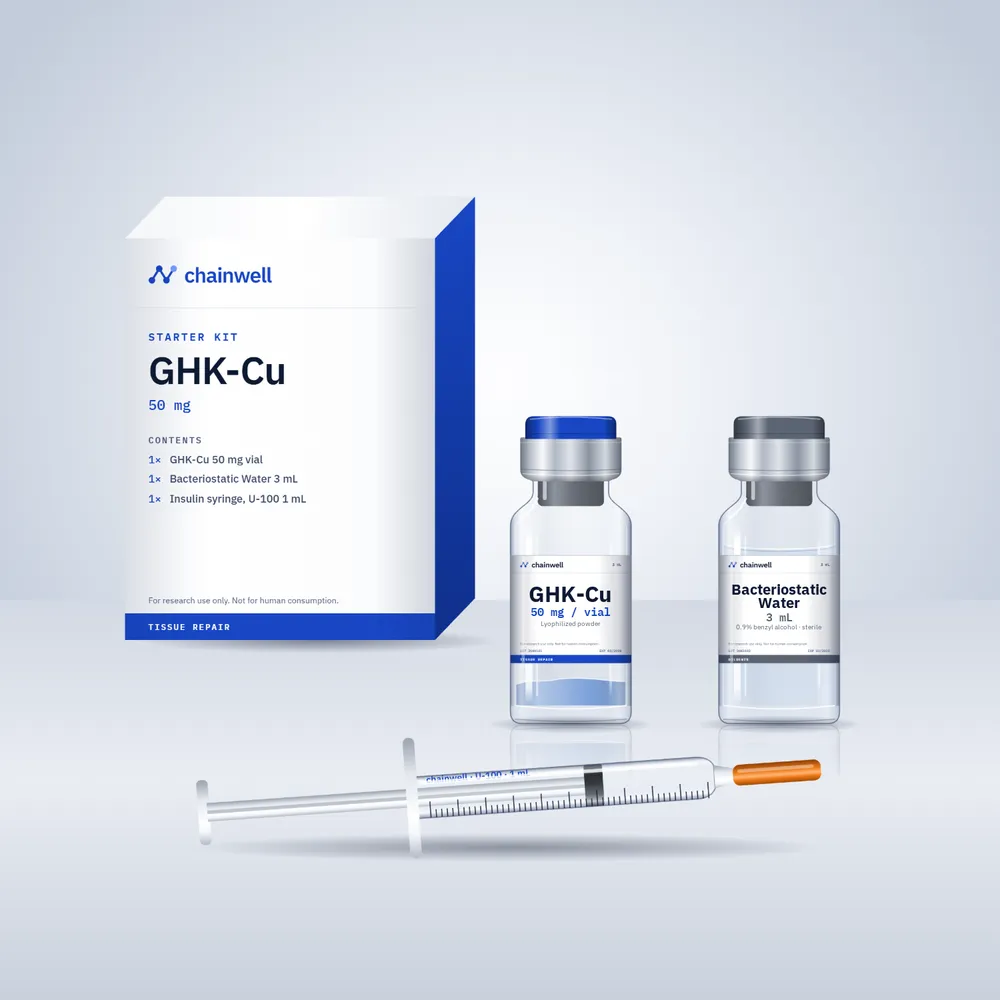
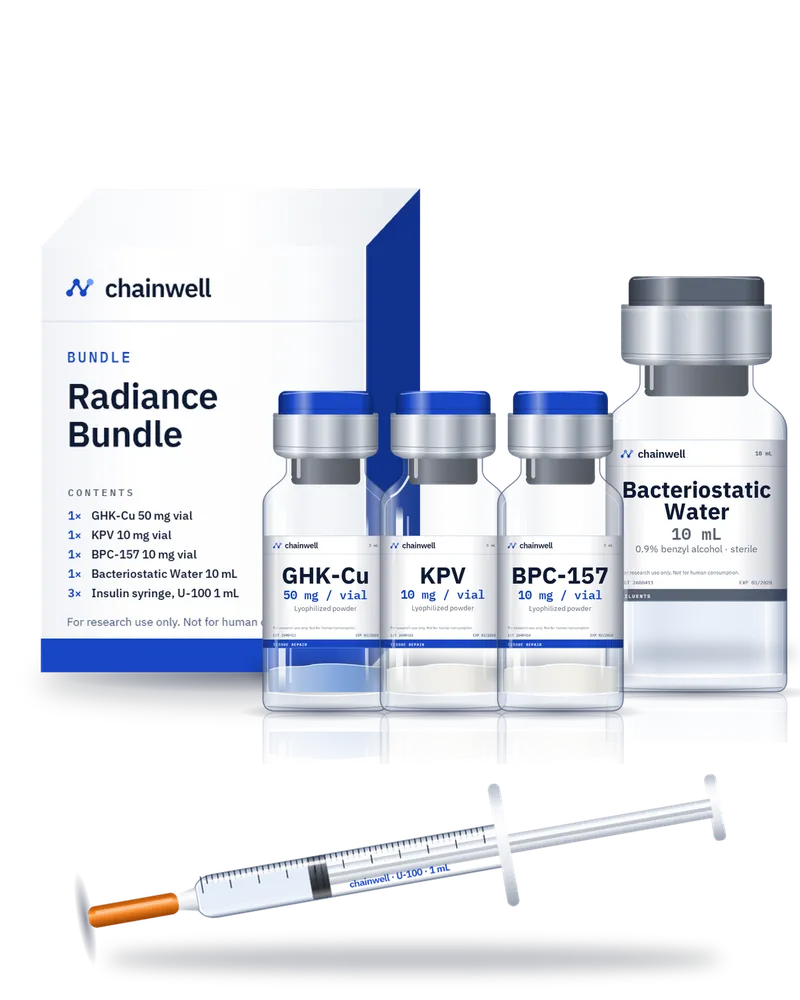
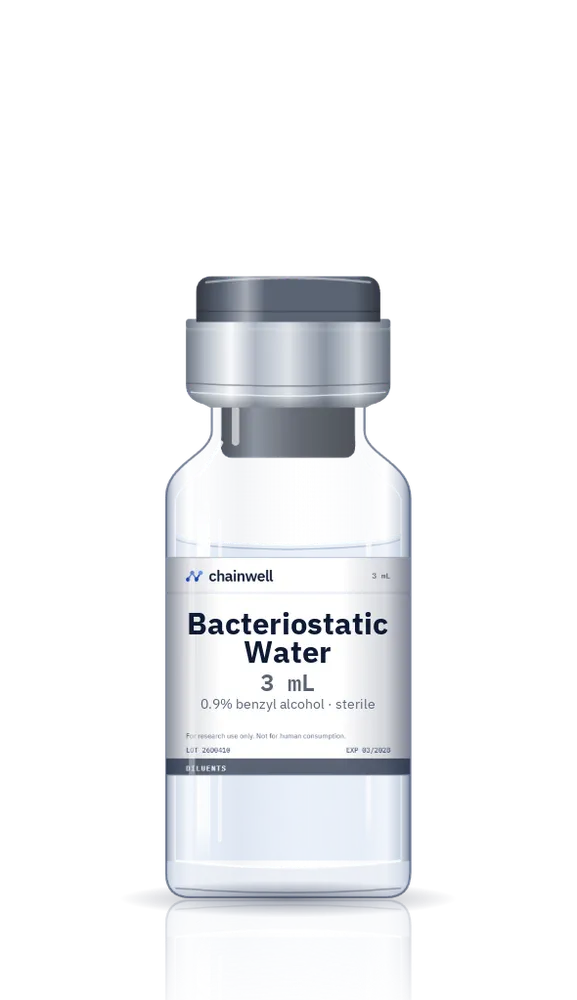
Our recommendation for labs starting copper peptide work: begin with a single GHK-Cu vial rather than a blend, so every result can be attributed to one compound. The GHK-Cu Starter Kit adds 3 mL of bacteriostatic water and a U-100 syringe to a 50 mg vial. For multi-compound skin models, the Radiance Bundle supplies GHK-Cu, KPV and BPC-157 as separate vials, and the rest of the range is in our skin and cellular research peptides.
Chainwell Peptide sells GHK-Cu for laboratory research use only, as set out in our research use only policy. Our vials are not cosmetics, are not formulated or tested for skin application, and must not be made into serums, creams or any product for personal use.
Frequently asked questions
Does Chainwell Peptide sell GHK-Cu serum or GHK-Cu cream?
+
No. Chainwell Peptide does not sell any GHK-Cu serum, cream, lotion or hair product. We supply GHK-Cu only as a lyophilized research compound in 50 mg and 100 mg vials, plus the GHK-Cu Starter Kit and the Radiance Bundle, all for laboratory research use. For a cosmetic, you would need a skincare retailer.
Is copper tripeptide-1 the same as GHK-Cu?
+
Yes. Copper tripeptide-1 is the INCI name used on cosmetic ingredient labels for GHK-Cu, the tripeptide glycyl-histidyl-lysine bound to copper. Tripeptide-1 on its own is GHK without copper, and palmitoyl tripeptide-1 is GHK with a fatty acid chain and no copper, so check the exact name on the label.
Can GHK-Cu serum be combined with vitamin C?
+
The chemistry argues against combining them in one formula. L-ascorbic acid needs a pH below 3.5 to penetrate skin, where the copper complex binds far more weakly, and copper catalyses the oxidation of ascorbate. Each ingredient degrades the other. Formulators typically keep them in separate products. For personal skincare questions, ask a dermatologist.
What concentration of GHK-Cu is in cosmetic products?
+
Usually very little. The US Cosmetic Ingredient Review found GHK-type peptides are typically used below 10 parts per million, with one submission citing 1 to 30 ppm. Many labels do not state a figure. Delivery systems such as nano-lipid carriers or liposomes matter as much as the amount, because GHK-Cu penetrates skin poorly on its own.
Can a GHK-Cu research vial be turned into a serum?
+
No. Chainwell Peptide GHK-Cu vials are laboratory reagents sold for research use only. They are not formulated, preserved or tested as cosmetics, and we do not provide instructions for making skin products from them. Anyone wanting a copper peptide serum should buy a finished cosmetic from a skincare supplier.